
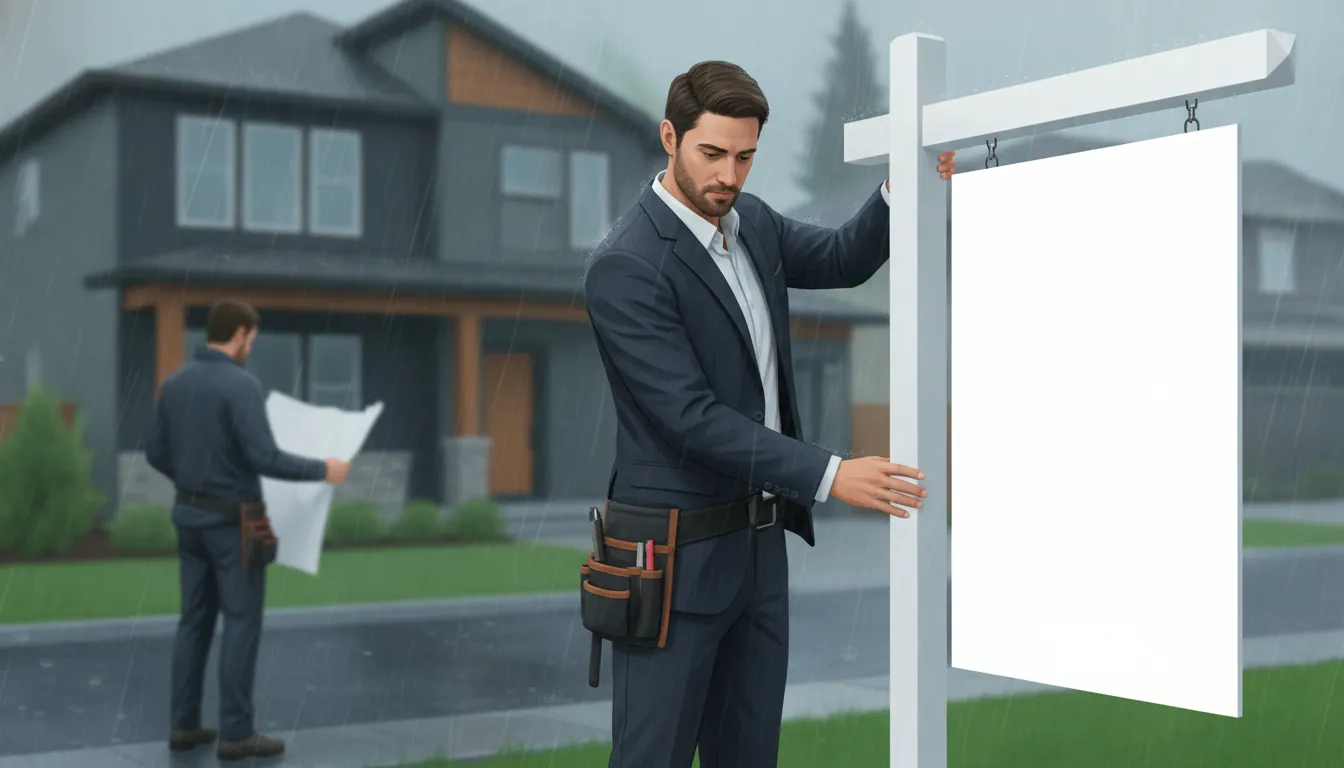
A property sign has to work before a prospective buyer ever reaches the listing. From the curb, people should be able to recognize the property, read the essential message, and understand where to turn next, even while walking or driving past. That makes the ordering process more than choosing a board and uploading artwork.
Contact APM PrintWorks to discuss your property-sign project
Effective real estate sign printing combines a readable design, a sign material suited to the listing conditions. Coordinated riders and supports, and a quantity plan that reflects each property and directional point. For Greater Portland agents and property teams, a local printer can also help confirm production details, delivery expectations, and the information needed for an accurate custom quote.
Start by treating every order as a small signage system. The main panel, optional rider, post or stake, artwork proof, quantity, and installation plan should agree before production begins. Here is what to define so your signs are practical in the field, consistent across listings, and ready for a smooth conversation with a Beaverton print partner.
What Real Estate Sign Printing Should Include for a Property Listing
Real estate sign printing is more than putting a listing message on a panel. For a property in the Greater Portland area, the job should coordinate the printed sign, approved artwork, installation support. Quantity, and delivery plan so the finished order is ready for the people responsible for placing and managing it.
Start with the listing information that must appear on the sign, such as the brokerage or agent identity, contact details, property status, and any directional message. Confirm the final artwork before production, including logos, colors, dimensions, orientation, and whether the sign needs to be readable by drivers or pedestrians approaching from a specific direction. A clear proofing step helps prevent a costly reprint when a phone number, logo, or property detail changes.
Then define the physical deliverables. APM PrintWorks describes its yard signs as durable corrugated plastic, lightweight, and portable. Each yard sign includes an H stake for installation, and the signs are intended to support repeated daily visibility. That combination can suit active listings, provided the order reflects the actual placement conditions and responsibilities for installation.
Quantity is part of the production plan, not an afterthought. Count the primary listing location, approved directional points, anticipated replacements, and any additional properties being ordered at the same time. Keep the artwork and quantity schedule organized by listing so the team can distribute signs accurately.
As a Beaverton commercial printer serving Greater Portland, APM PrintWorks can help real estate and property-development teams coordinate these details. When requesting a quote, provide the artwork status, sign dimensions, quantity, support needs, delivery location, and desired in-hand date. That gives the printer enough context to confirm the appropriate production plan without relying on assumptions.
How to Choose a Material for the Listing Conditions
Material selection should follow the job’s actual use, not a generic durability claim. Start by asking how often the sign will move, where it will be placed, and whether the listing needs a portable solution for changing properties. A short-term listing sign may prioritize easy handling and efficient deployment. A sign expected to support repeated daily visibility may justify a closer review of the substrate, finishing, support, and artwork requirements together.
For many property listings, corrugated plastic offers a practical starting point. APM PrintWorks describes its yard signs as durable, lightweight, and portable, which can help real estate teams move signs between active listings. Each yard sign also includes an H stake for installation. Those are useful production details, but they do not replace confirming the specifications for your particular project.
| Listing condition | Production priority | Questions to confirm |
|---|---|---|
| Short-term or frequently changing listings | Lightweight handling, portability, and an efficient repeat-order process | How will the signs be moved, stored, and redeployed between properties? |
| Listings requiring repeated daily visibility | A material and finishing plan that fits the placement and expected use | What exposure, installation conditions, and replacement process should the printer plan for? |
| Coordinated brokerage or development campaigns | Consistent artwork, dimensions, supports, and ordering details across locations | Which specifications must remain consistent from one property to the next? |
APM does not publish universal weather-life, thickness, ink, or warranty specifications for these signs, so avoid choosing based on an assumed lifespan. Instead, provide the listing conditions and intended use when requesting a quote. You can review additional custom yard sign options, then ask APM PrintWorks to confirm the material and production details that fit your Portland-area project.
How Should Signs, Riders, and Posts Be Planned Together?
A real estate sign order is easier to produce accurately when the main panel, any rider, and its support system are treated as one project. Rather than sending only a sign design, give the printer a complete placement and installation brief. That helps the team identify questions before artwork is finalized or materials are produced.
What to include in the quote request
- Main sign: Specify the finished width and height, whether the sign is single- or double-sided, and the quantity needed for the current listing or campaign.
- Rider plan: State whether a rider will be used, its intended message and dimensions, and where it should sit relative to the primary panel. Rider-to-sign fit and mounting compatibility should be confirmed for the exact combination. APM’s published information does not establish universal rider specifications.
- Support and mounting: Identify the intended post, stake, frame, or other support, along with any required holes, slots, brackets, or mounting hardware. APM states that an H stake is provided with each yard sign for installation, but post and rider compatibility still needs to be confirmed for the requested configuration.
- Delivery and installation: Clarify whether the order will be delivered to one location, divided among properties, or picked up, and identify who will install, move, or remove the signs. Include site access details when they affect handling.
APM describes its yard signs as lightweight and portable, with durable corrugated plastic construction and support for repeated daily visibility. Those characteristics can suit active property marketing, but the final quote should reflect the actual dimensions, components, quantity, and handling plan. If a common format is under consideration, review the 12×18 yard sign sizes guide, then send the complete sign, rider, support, and delivery details together for confirmation.
How Do You Make Real Estate Signs Readable from the Street?
Readable artwork starts with a clear information hierarchy. Decide what a passerby must understand first, such as the property status or agent identity, then make the next action obvious. Keep secondary details, including a phone number or web address, visually subordinate so the main message is not competing with contact information.
Contrast matters as much as color choice. Pair a dark type color with a light background, or the reverse, and check the design at full size rather than judging only from a monitor. Avoid placing important text over photographs, busy textures, or low-contrast brand colors. A simple background often gives a listing sign more working visibility than an elaborate design.
Choose letterforms that remain distinct when viewed quickly. The SUNY Buffalo signage resource explains that legibility depends on how easily one letter can be distinguished from another. It also describes readability as how easily words can be read at a distance and while moving. You can read the full signage guidance for that distinction. Use a straightforward typeface, adequate line spacing, and a mix of upper- and lowercase text when it improves word-shape recognition. Avoid condensed or decorative styles for essential details.
Build in generous whitespace around the name, message, logo, and contact details. Crowding makes a sign feel less organized and gives the eye fewer places to pause. Character height should reflect the sign’s intended viewing conditions. The same design may work near a driveway but fail when people see it from a moving vehicle. So review a proof at the largest practical viewing distance and ask whether the primary message is understood immediately.
Before approving real estate sign printing, verify every phone number, URL, agent name, brokerage detail, and listing status. Check the final proof for missing characters, unintended line breaks, and artwork that extends too close to the trim. A careful proofing pass protects the investment in the sign and prevents an avoidable reprint.
How Many Signs Should You Order?
There is no universal quantity for a real estate sign order. The right number depends on your active listings, the number of directional points for each property, replacement needs, and whether signs will be reused as listings change. Treat quantity planning as an inventory decision, not a guess based on another agent’s order.
Start with active listings and directional points
- List every property that needs a sign now.
- Count the primary sign and approved directional points separately for each listing.
- Add a realistic replacement allowance for signs that may be missing, damaged, or outdated.
- Separate reusable inventory from one-time campaign quantities before requesting the quote.
For each listing, confirm the locations with the listing team before adding them to the production count. A property with a straightforward entrance may need only its main sign, while a site set back from a busy road may require more directional coverage. Treat the result as a planning estimate, not a universal quantity.
Add a replacement and reuse allowance
Next, identify signs that may need replacement because they are missing, damaged, or no longer accurate. This is also the point to separate one-time campaign needs from reusable inventory. If the same design, size, and installation approach will serve multiple listings, an additional run may support future use. If branding or property details change frequently, avoid ordering more than the team can realistically deploy.
Document the quantity by sign type, listing, and delivery destination before requesting a quote. APM PrintWorks provides an H stake with each yard sign, while the exact production and delivery plan should be confirmed for your project. If the common 12-by-18 format fits your use case, review these 12×18 yard sign sizes before finalizing the order. A clear count helps APM’s Beaverton team recommend the most practical production plan for your Greater Portland listings.
What Affects Real Estate Sign Printing Cost?
A useful quote starts with a complete project brief. Real estate sign printing cost can change based on the material, finished dimensions, one-sided or two-sided artwork, color coverage, and the number of signs needed. APM PrintWorks uses custom quotes for yard signs and does not publish a standard price range. So the most reliable comparison comes from submitting the same specifications to each printer.
Include these details when requesting a quote:
- Material and size: Identify the intended material and finished dimensions. APM describes its yard signs as durable corrugated plastic, lightweight, and portable, but the right specification depends on the listing conditions and planned use.
- Artwork and finishing: Note whether production-ready artwork is supplied, whether revisions or design coordination may be needed, and whether the project requires trimming, drilled holes, or another finishing step. Clear files and an approved proof help keep the quote aligned with the final job.
- Supports and installation: State how the signs will be displayed and what support components are expected. APM provides an H stake with each yard sign for installation. Do not assume that a particular post, rider, mounting pattern, or hardware combination is compatible without confirming it for the project.
- Quantity and fulfillment: Provide the planned quantity, sign variations, packaging needs, delivery destination, and whether the order should be split among listings or locations. Revisions, repackaging, and coordination across multiple addresses can affect the scope.
Also confirm the current production estimate when you request pricing. APM does not publish a fixed timeline, and artwork readiness, quantity, finishing, delivery, and approval timing can all affect the schedule. For a Beaverton or Greater Portland project, review the yard-sign specifications and provide the listing count, artwork status, delivery details, and installation plan so the quote reflects the actual job.
What Should Portland Buyers Confirm Before Ordering?
A smooth order starts with a complete project brief, not just a request for real estate sign printing. Before sending files to production, confirm the property address or service area, the sign dimensions, the quantity, the intended viewing conditions, and who will receive the finished signs. APM PrintWorks is based in Beaverton and serves real estate and property-development teams throughout Greater Portland, so local coordination can be part of the conversation.
Review the artwork and approve the proof
Confirm that the listing information, agent or brokerage details, contact information, branding, and required disclosures are final. Ask for a proof that shows the actual layout, colors, copy, and any placement of logos before production begins. Check the proof at the intended viewing distance, especially if the sign will be seen by drivers or pedestrians. Readability depends on whether words are easy to interpret at a distance and while moving, not only whether they look correct on a computer screen. The University at Buffalo’s signage guidance explains this distinction in its discussion of legibility and readability: review the full accessibility and readability resource.
Confirm the estimate and handoff plan
APM does not publish a fixed turnaround for yard signs. The current estimate depends on project details such as the artwork, specifications, quantity, proof approvals, and delivery or pickup requirements. Confirm the production and delivery estimate before approving the order, and identify who is responsible for receiving the signs. Also clarify whether your team, a listing coordinator, or another provider will handle installation. APM states that an H stake is provided with each yard sign, but site-specific placement and installation responsibilities should still be agreed upon in advance.
Check current Portland and Oregon rules
Do not assume that a printed sign is automatically permitted wherever it is useful. Portland Title 32, also called the Sign Code, sets standards for sign design, construction, installation, and maintenance. The city also notes that signs in public rights-of-way are generally regulated under Title 17 rather than Title 32, with exceptions. Review the current Portland Sign Code and the city’s sign permit guidance for the property and sign type.
If a sign will be visible from an Oregon state highway, ODOT’s Outdoor Advertising Program may also apply to signs on private property. ODOT identifies circumstances involving compensation, location, temporary duration, and size that can affect permit requirements, and notes that additional criteria apply. Check the current ODOT permits and exemptions guidance and confirm requirements with the appropriate agency or property representative. This is practical planning information, not legal advice, and rules can change. Resolving these questions before proof approval helps your Beaverton print partner produce the right project without avoidable rework.
Request project details and a current quote from APM PrintWorks
Frequently Asked Questions
What is the best material for real estate signs?
The right material depends on the listing conditions, reuse plans, sign size, and support method. APM PrintWorks uses durable corrugated plastic for yard signs because it is lightweight and portable. Confirm the material, dimensions, and finishing details against the intended installation before approving the order.
Can real estate sign printing include custom riders?
It can, but rider dimensions, attachment method, mounting holes, and compatibility with the main sign and post should be confirmed before production. Include the rider message and final layout in the proof so the complete sign system is reviewed together.
How do I make real estate signs readable from the street?
Use a short message, strong contrast, clear letterforms, generous spacing, and a visual hierarchy that puts the key action or contact information first. Check the proof at a realistic viewing distance. The SUNY Buffalo accessibility resource explains that readability includes viewing distance and movement, not just whether letters are technically distinguishable: readability guidance.
How many real estate signs should I order?
Start with your active listings, the number of directional points for each property, expected replacements, and signs that can be reused. Treat that total as a planning estimate rather than a universal quantity. Share the count, sign size, and reuse plan when requesting a quote so production and packaging can be planned accurately.
How much does real estate sign printing cost?
Pricing depends on material, dimensions, artwork, finishing, supports, quantity, packaging, delivery, and revision needs. APM PrintWorks uses custom quotes rather than publishing a universal price range. Provide the specifications, quantity, artwork status, delivery location, and needed date to receive a current project estimate.
Ready to Plan Your Real Estate Signs?
Contact APM PrintWorks through the online form for a current quote and turnaround estimate.