
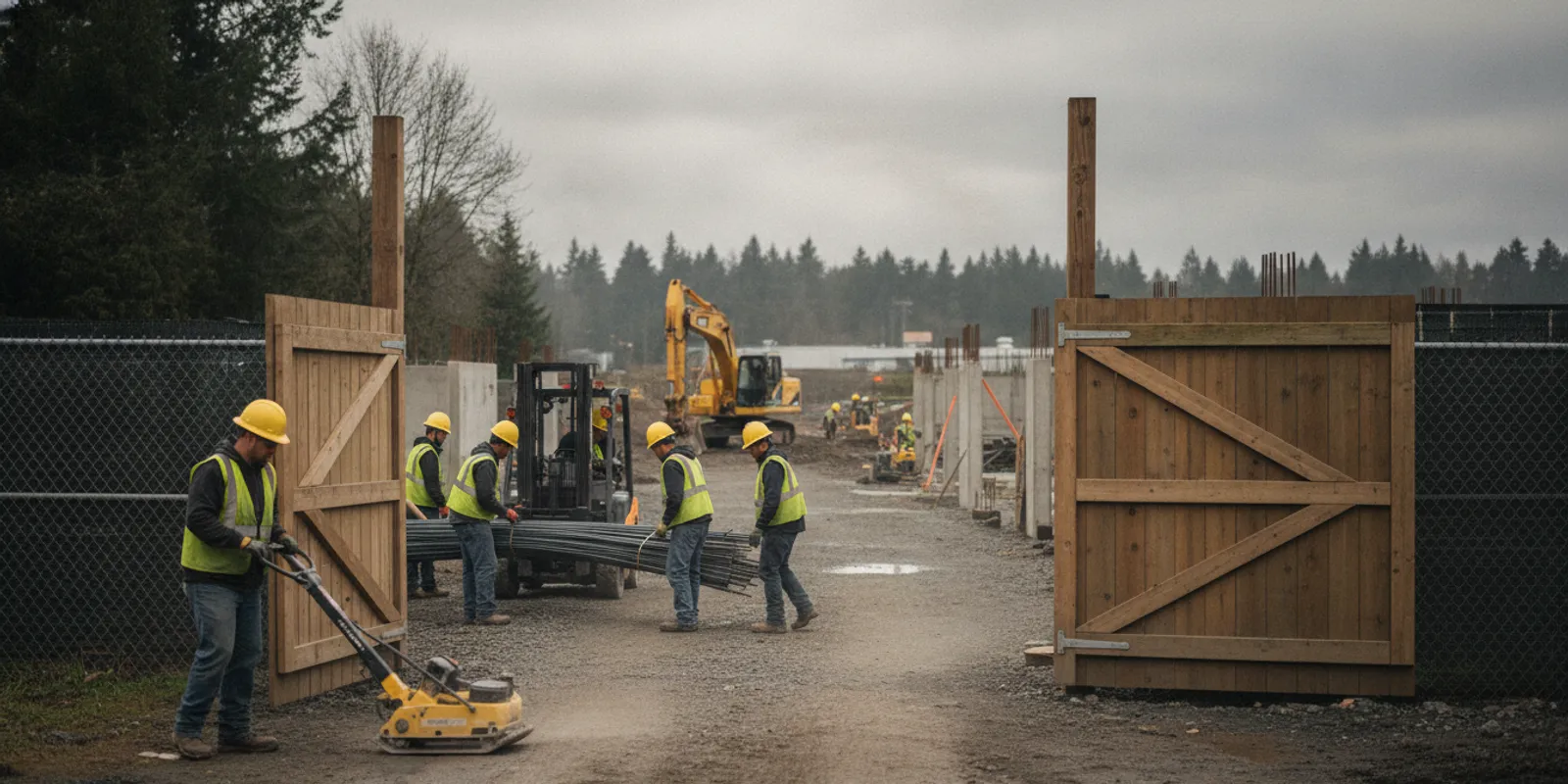
When a project deadline moves up, fast turnaround safety signs for construction sites still need to be easy to read, suitable for their location, and consistent with the site safety plan. A rushed order can create problems if the message is unclear, artwork is incomplete, or the sign format does not fit the installation area. A short, organized brief helps your team move quickly without treating legibility or durability as optional.
Discuss your safety sign project
What should you do first when sign needs are urgent?
Start by identifying the decision the sign must support. Is it directing people to an entrance, marking a restricted area, identifying a hazard, or showing where safety equipment is located? Keep the requested outcome clear. A sign that tries to communicate every site rule at once may be harder to understand than several signs, each with one defined purpose.
Next, ask the site supervisor or safety lead to confirm the approved wording, required symbols, placement, and any applicable project or regulatory requirements. The printer can help prepare and produce the graphic, but the project team is responsible for confirming the safety message and where it belongs. Do not assume that a generic warning panel satisfies a site-specific plan.
Before requesting production, collect five essentials: final copy, sign dimensions or available space, intended viewing distance, quantity by location, and the date and method the signs must be ready. Add a site photo or simple placement sketch if the sign has to fit an existing frame or a particular surface. This gives the production team something actionable to review instead of a deadline alone.
If the sign relates to a recognized hazard symbol, verify the intended pictogram with the person responsible for site safety. A reference such as APM PrintWorks’ OSHA pictograms guide can help teams review symbol meanings, but it is not a substitute for the project’s safety review or applicable rules.
Which messages should a construction safety sign prioritize?
Write the message for the person who will encounter it, not for someone who already knows the work plan. A visitor approaching a gate may need to know where to report or which area is off limits. A worker entering a specific zone may need a clear hazard notice or required action. A delivery driver may need directional information before reaching a busy vehicle route. These are different communication jobs and may call for separate signs.
Use a practical hierarchy. Put the essential instruction or hazard at the top of the review list. Add a short explanation only when it changes what the reader should do. Include secondary details, such as a contact or location reference, only if people can read them at the expected distance. Longer copy may be appropriate at a point where people stop, but it is a poor fit for a sign meant to be noticed while walking or driving past.
Keep terminology consistent across the site. If the safety plan uses a particular name for a restricted zone, use that same name on the sign. Ask the safety lead to check spelling, capitalization, symbols, and any translated text. A printer can lay out supplied copy, but should not be asked to guess at the meaning of an instruction or to invent a compliance statement.
For equipment locations, the wording and placement should make the location easy to identify. Virginia Peninsula Community College’s safety guidelines note that signs should identify locations for safety showers, eyewash stations, first aid kits, exits, and storage areas. That is useful context when deciding whether a sign is a warning, a direction, or a location marker; the site team should still confirm what applies to its own project.
How do you choose a sign format and material?
Match the sign to the place and the way people will see it. First note whether it will be outdoors or indoors, exposed to rain or direct sun, viewed at close range or from farther away, and installed on a wall, gate, temporary barrier, or other surface. Also consider how long the message is expected to remain in place and whether the sign may need to move as work areas change.
Rigid panels can suit fixed locations where a stable, flat display is useful. Flexible graphics may be relevant for some temporary or broad-area uses, while adhesive graphics can suit a smooth, prepared surface when that placement is appropriate. These are general format considerations, not a claim that one material works for every site. Ask the printer which available construction and finish fit the exposure, mounting method, and intended service period.
| Site need | Format to discuss | Key planning question |
|---|---|---|
| Fixed entrance or equipment location | Rigid sign panel | What size and mounting surface are available? |
| Temporary boundary or broad viewing area | Large-format panel or banner, where suitable | How will it be supported, and what weather exposure is expected? |
| Clean, smooth interior surface | Adhesive graphic, if the surface allows | Is the surface compatible, and can the graphic be removed later? |
| Repeated locations with the same instruction | Consistent sign set in a selected format | How many placements, sizes, and message versions are needed? |
For broader site communication, APM PrintWorks produces site signs and other custom sign solutions. If the project calls for a large graphic across a temporary boundary, ask whether a mesh banner is suitable for the particular placement. A banner is not automatically a substitute for a required safety sign; the project team should decide whether its format and message satisfy the intended purpose.
What artwork helps a printer move the order forward?
The most useful starting point is approved copy and a clear specification, not a complicated design file. Provide the finished wording, preferred sign dimensions, quantity, intended viewing distance, location, and any required colors or symbols. If you have a prior sign that the new one must match, share a photograph or the original production file. Identify what must remain unchanged and what can be adjusted for the new size.
When your team supplies artwork, ask which file types and production specifications the printer can accept before exporting a final version. Include fonts and linked image files where needed, and confirm that the document dimensions match the requested finished size. Avoid sending several unlabeled alternatives without indicating which one is approved. Label the final copy and art clearly, then keep one person responsible for sending changes.
If the team does not have print-ready art, send the content in an editable document and explain the desired hierarchy: what must be noticed first, what is supporting information, and what should be omitted. A site photo or rough layout can show the available space. Allow the printer to prepare a proof, then route it to the person authorized to approve the message. Check both the visual layout and every word, number, symbol, and location reference before giving approval.
For an urgent order, proof approval is a real production step, not a formality. Agree on who will review it and how that person can respond. A late copy change or an unanswered proof can affect the schedule even when the design itself is straightforward. If a change is necessary, send one consolidated correction list rather than separate notes from several reviewers.
How should you calculate quantities for a changing site?
Count the sign locations, not just the number of sign types. Walk the relevant route or review a current site plan with the supervisor. Record each location, the message required there, the approximate size, and the number of faces that need to be visible. A single entrance may need a different sign from a work zone or equipment point, even if both share a general safety theme.
Separate identical signs from variants. For example, a batch might contain several copies of one approved message plus a small number of location-specific versions. List each version separately, with its exact copy and count. This reduces the risk of producing the right total quantity but distributing the wrong message to a particular area.
Then ask whether the installation plan includes a reasonable allowance for signs that are damaged, moved, or needed at a newly active area. Avoid ordering extras without a reason: multiple approved versions, changing phases, or site locations that need replacement may justify a reserve, while an undefined buffer can add cost and create unused stock. The site manager can help balance the consequences of a shortage against the possibility that project conditions will change.
If signs will be repositioned as work progresses, plan who will move them and how the team will keep the current placement list. For a multi-location project, a simple schedule with a location code, message, size, and quantity can help both the site team and printer track the order. A clear schedule is especially useful when different areas need different versions.
What affects the quote and production timing?
Custom safety sign work is priced according to the project rather than a universal per-sign figure. The quote can depend on the dimensions, chosen material, number of copies, number of unique designs, artwork preparation, finishing, and whether delivery or installation coordination is needed. A set of identical panels is different from a group of signs with separate wording, sizes, and production requirements.
For an accurate estimate, provide the complete scope at once. Include the required quantities by version, dimensions or size range, approved or draft artwork, surface and exposure notes, destination, and requested in-hand date. Tell the printer whether the date is a firm deadline and whether delivery, pickup, or installation is part of the request. Ask which factors are still uncertain and whether any alternatives could simplify production while preserving the sign’s purpose.
Do not treat an urgent request as a confirmed production promise. Ask the printer to confirm the schedule after reviewing the specification, artwork, materials, approval needs, and delivery plan. A printer may need to clarify a detail before estimating timing. If the deadline is fixed, say so at the start; if there is flexibility, explain which date or requirement can move.
For a project with many sign types, request that the quote identify the versions and quantities being priced. That makes it easier to compare a revised scope if the site team changes its request. It also helps prevent a budget discussion from obscuring a safety need: if a particular sign is essential, state that clearly and ask about viable production options rather than silently removing it from the order.
How can you coordinate a tight production schedule?
Work backward from when the signs must be usable at the site. Include time for the safety lead to finalize wording, the printer to review the request, artwork preparation, proof review, production, and delivery or installation arrangements. Do not set a production expectation from a general online estimate or a previous job; material, quantity, artwork, and current workload can differ.
Choose one decision-maker to collect feedback and approve the proof. Before the proof is sent, make sure the people responsible for safety, project operations, and brand presentation have reviewed the proposed copy and layout. This prevents a late-stage request to change a hazard message or add a new location after production has been planned.
Keep the project information in one current version. A concise order brief can include the deadline, site contact, delivery point, access instructions, sign schedule, artwork files, and approval contact. If the delivery location has restricted access or limited receiving hours, make that clear. If a printer is expected to coordinate installation, identify the site contact and any access or safety procedures that installers must follow.
When requirements change, tell the printer immediately and ask what the change means for the quote and schedule. Changes to quantities, sizes, copy, material, or destination may affect the work. Request a revised confirmation so your team is not relying on an outdated proof or assumption. This communication habit is more dependable than hoping a last-minute change can be absorbed without impact.
Some safety-related sign messages may need particular care. Virginia Tech Environmental Health and Safety, for example, instructs that a “No Open Flames” sign be posted on access doors to areas that use or store flammable gases. Use that source for the specific example it addresses, and have the site safety lead determine the applicable message and placement for the actual job.
What should you check before approving the finished signs?
Review the final proof at the actual finished dimensions, or ask how it will read at the planned viewing distance. Look for a clear visual priority, readable lettering, and enough contrast between the message and its background. Check that no essential line is crowded near an edge or obscured by a proposed mounting point. More decorative detail is not an advantage if it makes the instruction harder to notice.
Proofread every version independently. Confirm the exact wording, spelling, punctuation, numbers, symbols, language, and location references. Check quantity and size against the schedule. If a sign refers to a door, gate, area, or piece of equipment, make sure that reference matches the site plan. Have the authorized safety reviewer approve any safety instruction before it is released.
Finally, confirm what will be delivered and how it will be handed off. Verify the number of signs by version, finished dimensions, selected material, delivery point, and expected arrival or installation arrangement. Keep the approved proof and final location list with the project records. These checks can catch a mismatch before the crew depends on the signs in the field.
How can Portland-area teams prepare a useful request?
For construction teams in Greater Portland, working with a local printer can make it easier to discuss a site-specific request, review a proof, and coordinate project details. APM PrintWorks is based in Beaverton and serves the Portland metropolitan area with commercial printing solutions, including large-format signs. The best way to begin an urgent request is to explain the deadline and provide a complete scope, then confirm what production schedule is feasible for that specific job.
Before contacting a printer, gather the approved message, quantity by version, dimensions or available space, intended location, exposure conditions, artwork, required date, and delivery or installation needs. If you are still deciding on the format, describe the site conditions and ask for options. APM’s site sign information and broader sign services are relevant starting points for discussing a project. For large-format graphics serving a different purpose, review the company’s banner options as well, and keep mandatory safety messages distinct from promotional or general site graphics.
Think of the request as a short production brief. Make the deadline visible, name the person who approves copy, and say what can or cannot change. That gives the printer a basis to assess the project rather than asking for a turnaround estimate without enough information.
Send your sign specifications for a quote
Frequently Asked Questions
Can a printer guarantee a fast turnaround before reviewing the details?
A schedule should be confirmed for the specific order. The printer needs to review the sign sizes, quantities, artwork, material, proofing requirements, and delivery or installation plan. Share the required date early and ask for a clear confirmation rather than assuming a previous project’s timing will apply.
What information should I send for a rush safety sign quote?
Send the approved copy, dimensions, quantity for each version, artwork or reference image, site conditions, destination, and date needed. Include the name of the person who can approve a proof. If a detail is not final, mark it clearly and ask whether that open question affects the estimate or schedule.
Should all construction site signs use the same material?
Not necessarily. A fixed outdoor location, a temporary boundary, and a smooth indoor surface can create different needs. Describe exposure, mounting surface, viewing distance, and how long each sign should remain in use. The printer can discuss available formats, while the project team decides what is appropriate for its safety plan and installation conditions.
Can the printer write or approve the safety wording?
The printer can help arrange supplied content and prepare a proof, but the construction team should have its designated safety reviewer approve the message, symbols, and placement. Follow the project safety plan and applicable requirements. Do not rely on a production proof as a substitute for a safety review.
What if some signs are needed sooner than the rest?
Separate the scope by required date and identify which messages are essential first. Ask whether the printer can assess a phased production plan for the specific materials, quantities, and artwork. Confirm any change to cost, delivery, or the remaining schedule in writing before revising the order.
Talk with APM PrintWorks about your site signs
A complete brief and timely safety review help your team move an urgent sign project forward while keeping the finished messages clear, appropriate, and ready for the places they need to serve.