
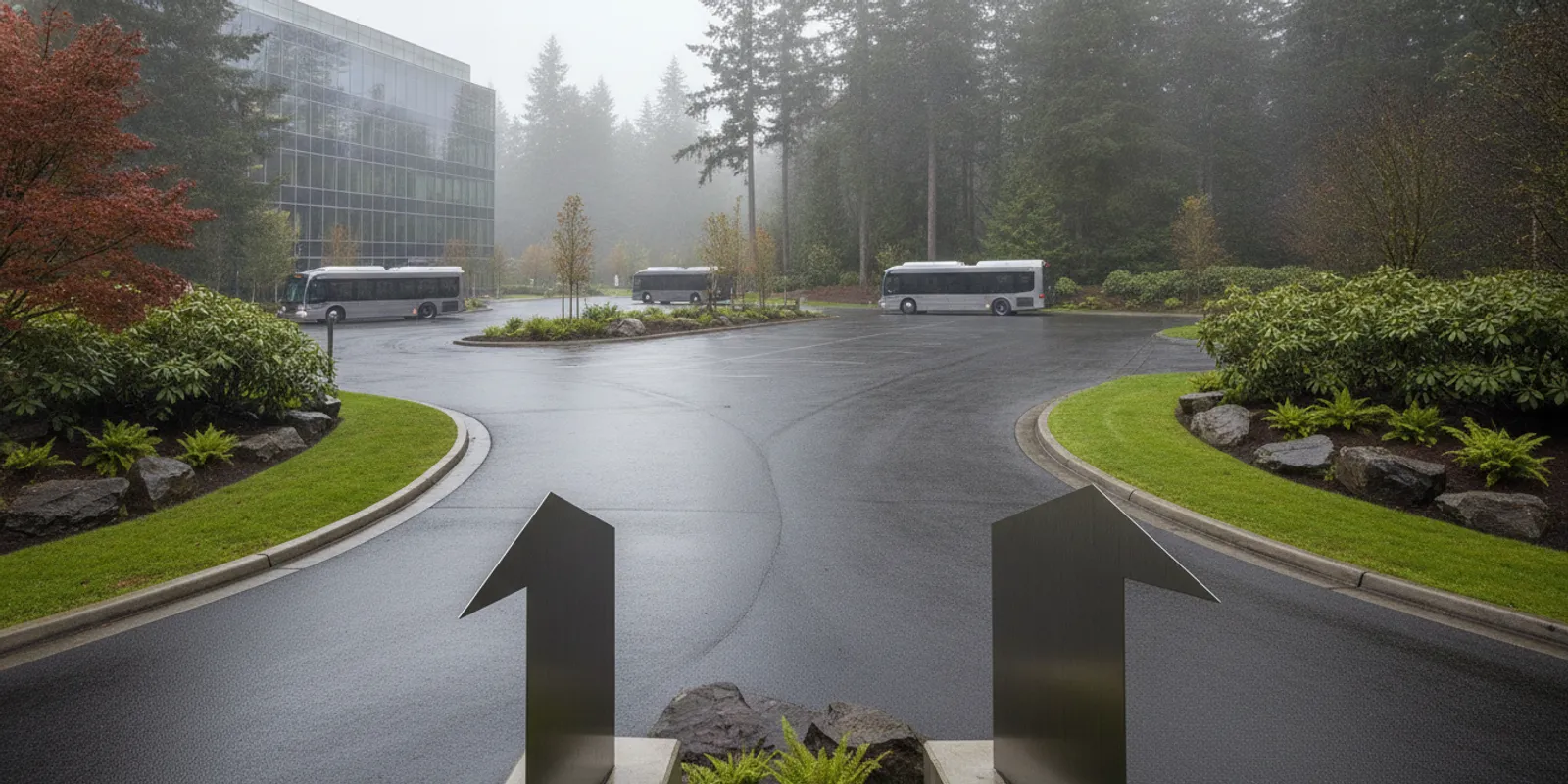
Planning parking signs Portland OR property managers can rely on starts with the way people actually enter, move through, and leave a property. A useful plan connects each message to a decision point, rather than placing signs wherever space is available. This guide shows how to audit a busy site, organize messages, improve visibility, coordinate mounting, replace inconsistent signs, compare quotes, and prepare a proof that is ready for production.
Discuss your parking sign project
What should a parking signs Portland OR site walk cover?
Walk the property as if you were a first-time visitor. Begin at every street entrance and follow each likely route to its destination: visitor parking, tenant areas, a reception entrance, a loading point, an employee area, or an exit. At every branch, ask what a driver needs to know before choosing a direction. Then repeat the walk on foot. This second pass can reveal places where people cross vehicle paths, miss an entrance, or cannot see a message from a safe stopping point.
Make a simple base map, even if it is only a marked-up property plan. Show entrances, aisles, parking rows, pedestrian routes, loading areas, building entrances, and any route that changes during certain hours. Number proposed sign locations and take a photo from the approach direction for each one. A close-up photo may show the panel, but it does not show whether a sign can be seen before a turn or whether a parked vehicle blocks it.
- Record what the reader should do at each location and whether the sign addresses a driver, cyclist, delivery person, or pedestrian.
- Note the viewing distance, likely approach speed, available stopping space, and competing visual information.
- Identify obstructions such as trees, fences, parked vehicles, building corners, lighting, utility equipment, or other signs.
- Write down when a rule applies, including hours, days, tenant changes, deliveries, or event conditions.
- Mark signs that are damaged, faded, inconsistent, out of date, or no longer needed.
- Record the direction of travel shown in each photo so an arrow is not interpreted from the wrong viewpoint.
In the Portland area, check the site in more than one condition if weather or seasonal foliage changes the view. Rain, glare, low winter light, and full summer landscaping can affect what an arriving driver notices. If a property is busiest at a particular time, walk it then. A sign that looks obvious during a quiet midday visit may disappear into visual clutter during a busy arrival period.
The site walk documents actual conditions; it does not replace review of property rules, permits, accessibility needs, or applicable traffic requirements. Keep those responsibilities clear. The property owner, manager, design professional, or relevant authority may need to approve specific restrictions, locations, or mounting arrangements.
Which messages belong in the sign plan?
Write a message inventory before selecting dimensions, materials, or artwork. Start with the problem each sign solves. A short, direct instruction usually serves a driver better than a full policy paragraph. If the reader needs several kinds of information, decide whether they belong on separate signs at separate points instead of compressing them into one crowded panel.
| Sign purpose | Question to answer | Useful planning location | Review point |
|---|---|---|---|
| Entry and orientation | Where should a visitor go first? | Entrance or first route choice | Can the driver identify the destination before turning? |
| Directional guidance | Which aisle or area leads to the destination? | Before a turn or split in vehicle flow | Does the arrow match the approach direction? |
| Reserved or restricted spaces | Who may use this area, and when? | At the applicable spaces or their approach | Is the rule approved and easy to associate with the spaces? |
| Loading and service areas | Where should deliveries stop or avoid stopping? | Before entry to the operating area | Can a delivery driver read it before committing to the route? |
| Pedestrian reminders | Where do people cross or need to take care? | At vehicle and foot-traffic intersections | Is the message placed where people can react? |
| Destination identification | How will someone know they have arrived? | At a building, lot, or designated area | Does the wording agree with maps and other signs? |
Use the table as a planning aid, not as prescribed legal wording. Confirm who has authority to approve each message. A property manager may be able to approve visitor directions but need an owner or relevant authority to verify a restriction or traffic instruction. Capture the approved wording and its intended location in the same inventory so production and installation do not rely on informal recollections.
For background on shared parking planning, consult the government-published Shared Parking Handbook chapter. Its context is not a substitute for local approval or a site-specific review. For the production side of the project, review APM PrintWorks’ custom sign printing options and the matching site signs page.
How do you build a message hierarchy?
Not every word on a sign deserves equal emphasis. Put the principal instruction first, then add only the condition or detail needed to act on it. For example, a driver approaching a visitor area may need a destination and an arrow. A separate panel at the destination may explain who can park there. Combining the full policy, hours, contact details, and directional information at the entrance can make all of it harder to use.
Sort each message into three levels. Level one is the action or destination, such as visitor parking, exit, or loading area. Level two is the clarification, such as enter at the rear drive or deliveries only. Level three is supporting information such as hours or a contact instruction. If level three makes the first two difficult to see, move it to another sign or another location.
Use familiar terms consistently. If the site calls a location “Building B,” do not call it “West Office” on the next sign unless both labels are genuinely needed. Make arrows agree with the route from the reader’s viewpoint. Avoid relying on color alone to distinguish two instructions; wording, shape, position, or a clear symbol should also carry the meaning.
For a practical test, print or display a proof at its proposed finished size and ask someone unfamiliar with the property to describe what they would do after a quick glance. If the person needs a long explanation from the manager, the sign may be carrying too much information or appearing too late in the route.
Where should signs go for useful visibility?
Place directional information before the choice it governs. A sign placed after a turn may confirm a route, but it cannot help a visitor choose the right aisle. Similarly, display a restriction before a driver commits to entering the affected area. For complex sites, plan a sequence: an entrance sign establishes orientation, a second sign confirms the route, and a destination sign identifies the area.
Inspect each position from the relevant approach and at more than one height where practical. Check whether a vehicle, open door, landscaping, pole, fence, temporary object, or snow storage area blocks the message. Consider whether headlights, sunlight, rain, or nearby illuminated displays create glare. Where a driver cannot safely stop to read a longer instruction, move the explanation to a place where stopping is expected or simplify it.
Plan for the route, not just the panel. If a visitor must make three decisions, check that the sign sequence remains understandable after each one. A useful sequence might be an entrance identifier, a directional sign before the first split, a confirmation sign near the destination, and a restriction sign at the controlled area. Too many repeated panels can create clutter, but too few can leave a driver guessing at the exact point where a choice matters.
Keep signs from interfering with accessible routes, vehicle sightlines, building access, or other required information. Confirm placement permissions and mounting details with the site owner or responsible professional. A photograph is useful for planning, but it cannot confirm underground utilities, surface condition, structural capacity, or the appropriateness of a particular mounting method.
How should you coordinate material and mounting choices?
Describe the environment before asking for a specification. Note whether each sign is indoors or outdoors, sheltered or exposed, likely to be handled, and expected to remain in place or change periodically. Record the mounting surface and location where known. These details help a print partner discuss suitable construction and finish rather than choosing from appearance alone.
Separate the printed sign from hardware, delivery, site preparation, and installation when those items are handled differently. Confirm who checks permissions, measures the final location, and installs the sign. A coordinated job benefits from a location schedule that pairs every item with a sign number, approved message, dimensions, and site photo.
For signs that may change, keep editable artwork and a record of the final approved version. Identify who can authorize wording updates and who will remove superseded signs. If a property has several entrances or tenants, give each sign a durable identifier in the maintenance record. That makes it easier to report “sign P-07 is blocked” than to describe a location from memory.
When comparing mounting approaches, ask practical questions rather than choosing on appearance alone. Will the sign be removed seasonally? Does the surface allow drilling? Is access available for a lift or other equipment? Could a panel be struck by vehicles or carts? Does the proposed position leave enough room for people to use the route safely? The answers affect scope and should be known before the quote is treated as final.
For consistent artwork across a larger program, review APM PrintWorks’ creative services. You can also compare related large-format applications through the company’s banner printing page when a project includes broader site graphics.
How do you replace old or inconsistent signs?
Begin with an inventory rather than a blanket replacement order. One damaged panel may need urgent attention, while a faded sign in a low-use area may wait until the next coordinated update. Rank each item by whether its message is inaccurate, unreadable, missing at a decision point, or simply inconsistent with the current visual system.
- Correct information that conflicts with current site rules, destinations, or operating hours.
- Address missing or unreadable directions where people must choose a route.
- Replace damaged signs that no longer communicate the intended instruction.
- Resolve signs that use different names, arrows, symbols, or visual treatments for the same function.
- Standardize lower-priority items and remove signs that no longer serve a purpose.
Use a simple priority score if the property has many signs. Give the highest priority to information that could send people the wrong way, misidentify a restricted area, or create confusion at a busy crossing. Give the next priority to signs that are hard to read or absent at a required decision point. Cosmetic consistency can follow when the budget or schedule requires phases.
Before ordering, ask an accountable person to verify every rule, reserved area, time condition, contact instruction, and delivery procedure. Then check the map against the inventory. Label photos with the sign number, approach direction, and replacement note. This cross-check helps prevent an accurate new sign from being installed at the wrong location.
If work must happen in phases, plan the transition so old and new messages do not conflict. Temporary notices should have an owner and a removal date. When a route changes, check every sign that refers to it, not just the panel closest to construction. The inventory can become a maintenance record: date each review, note damage or obstruction, and update approved wording when site operations change.
How do you scope parking signs Portland OR quotes and timing?
Parking sign pricing depends on quantity, finished dimensions, material, finish, artwork preparation, mounting, delivery, and installation. APM PrintWorks prices parking signs on a custom quote, not a published per-sign price list. Cost changes with quantity, finished size, material, finish, artwork preparation, mounting, delivery, and whether installation is included. Ask for a project-specific quote before treating any figure as an approved budget.
Quantity changes the comparison in more than one way. A single replacement panel may have setup and preparation costs spread across one item, while a coordinated set may make artwork preparation more efficient per sign. A multi-location order can still require different sizes, finishes, or mounting details. List each sign type separately instead of giving only a total count.
APM PrintWorks treats fast turnaround as a core production promise, but it does not publish a fixed number of business days for parking signs. Site review, proof revisions, special materials, quantity, and installation coordination all change the schedule. Ask the printer to confirm when production starts and what the current timeline is for your scope. If a deadline is fixed, include it in the first inquiry and name the approval dates that could affect it.
To compare proposals fairly, send each provider the same scope:
- Quantity and finished dimensions for every sign type.
- Approved wording or clearly identified draft messages.
- A marked site plan and photos taken from the approach direction.
- Indoor or outdoor exposure, mounting surface, and relevant site conditions.
- Whether artwork, hardware, delivery, or installation is requested.
- Target in-hand date and any review or approval milestones.
- Any phased delivery plan, tenant coordination, or removal of old signs.
Ask for costs to be separated by production, preparation, and installation where applicable. Check whether revisions, delivery, packaging, or replacement proofs are included. If proposals differ, compare the specification line by line rather than assuming the lower total covers the same construction or service.
APM PrintWorks is a Portland-area commercial printer based in Beaverton, serving Greater Portland businesses and organizations with printing solutions including signs. That local presence makes it practical to discuss site photos, scope, and production timing with a nearby print partner. A local conversation can also make it easier to clarify whether the requested work is production only or includes creative support, delivery, or installation coordination.
What should you check before approving a proof?
Proof approval is the point to catch a wrong arrow, outdated condition, misspelling, or incorrect sign count before production. Have someone responsible for site operations verify the wording and someone familiar with the property confirm placement. Do not assume a correct design automatically means the rule or route is correct.
- Compare every line of wording with the approved message inventory.
- Check hours, restrictions, punctuation, spelling, arrows, and destination names.
- Match dimensions, quantity, material, and finish to the quote.
- Review contrast, text prominence, and legibility at actual size.
- Confirm the sign number and installation location against the map and photo.
- Check that related signs use the same destination names and directional logic.
- Confirm the final file version and record who approved it.
Review the proof in two ways. First, inspect the file closely for content and production details. Second, view it from a distance similar to the real approach. The second test may reveal that supporting text is too prominent, an arrow is easy to misread, or the main instruction does not stand out. If a change is needed after approval, request a revised proof and check affected details again.
For outdoor directional projects, see site sign information. If the same property needs a related floor-level wayfinding element, review the live floor graphics page and keep that application separate from vehicle-facing sign decisions.
Request a parking sign project quote
Frequently Asked Questions
Do parking signs need to follow a standard format?
Requirements depend on the sign’s purpose, location, and property type. Ask the property owner or manager and relevant authority to confirm applicable requirements before approving wording or placement. Do not treat a general planning guide as legal approval.
Should every parking rule go on one sign?
No. Separate messages by purpose and put each where it matters. A concise instruction at the relevant decision point is easier to act on than a crowded panel combining unrelated policies. Use a second sign when a condition needs more explanation than the approaching reader can safely absorb.
What information helps a printer quote accurately?
Provide quantities, dimensions, final or draft wording, a marked location map, approach photos, exposure conditions, mounting expectations, and the date needed. State whether you need artwork support, delivery, or installation so the quote reflects your actual scope.
How far ahead should a property manager order?
Allow time for site review, message approval, proofing, production, and installation coordination. A simple repeat order may take less time than a multi-location project. Confirm the current schedule with the printer before setting a completion promise, and build in time to resolve proof corrections.
What is the best way to handle a phased sign replacement?
Start with inaccurate, missing, or unreadable signs at important decision points. Keep a numbered inventory, approve the full message set, and record which locations are complete. Give temporary notices an owner and removal date so old and new instructions do not remain in conflict.
Plan your next step
Plan your Portland parking signs with APM PrintWorks
A well-documented sign plan connects each message to a real decision point. It gives a Portland print partner the details needed for a useful quote, makes replacement work easier, and helps people move through a busy property with less guesswork.