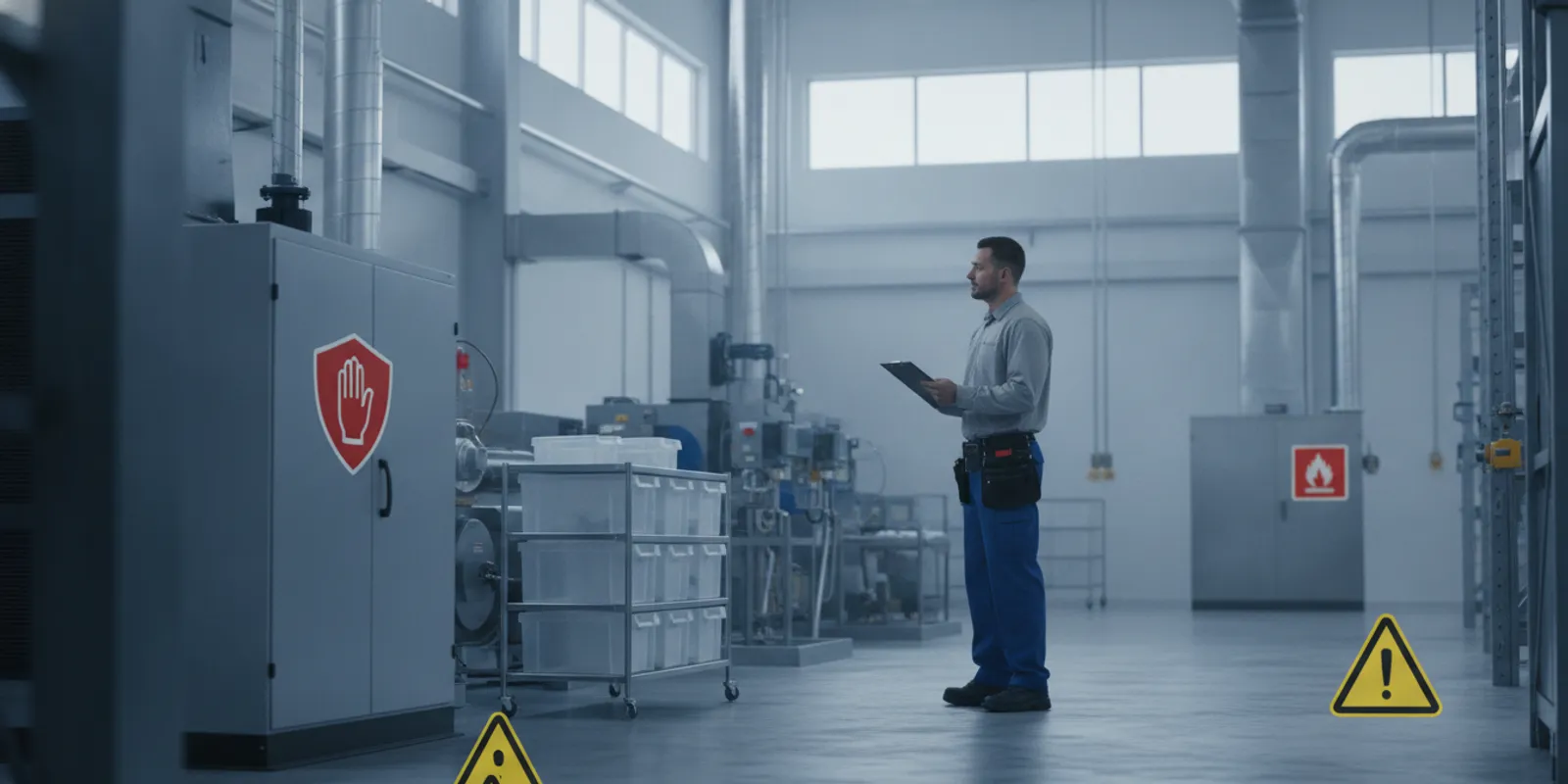
Planning safety labels for a facility starts with a practical question: what must a person understand at the exact place where an action occurs? A label can identify equipment, call attention to a hazard, provide a point-of-use instruction, or distinguish similar materials. The right size, face material, adhesive, and production process help keep that message legible and attached. This guide explains how Portland-area businesses and organizations can plan a label program that fits the facility, the surface, and the people who will use it.
Discuss your facility label project
APM PrintWorks is a local Portland-area printing partner based in Beaverton. Its consultative Dream, Plan, Create approach gives a project team a way to organize the goal, message, conditions, artwork, and production details before creation. That preparation matters because a label that looks clear on a screen may be too small for the real surface, may use the wrong adhesive, or may be difficult to verify when several versions are produced.
What should safety labels do that signs do not?
A safety label is usually attached to, or placed immediately beside, a specific object, container, control, pipe, door, or surface. Its meaning is tied to that location. It may identify an asset, warn about a condition, show a required precaution, or prompt an inspection or operating step. A sign is generally larger or positioned to communicate across a room, route, work zone, or property.
The distinction is useful, but it is not absolute. A facility may need both formats. A label on equipment provides information at the point of use, while a sign at the entrance to the area explains the broader restriction or route. A label should not be forced to carry an entire procedure in small type, and a large sign should not be used when the reader needs item-specific information.
| Planning consideration | Safety label | Facility sign |
|---|---|---|
| Typical placement | On or immediately beside an item or surface | Wall, door, post, entrance, or visible location in a space |
| Primary purpose | Identify, warn, or prompt an action at point of use | Direct, identify an area, or communicate across a space |
| Message scale | Short, focused information | Message sized for a route, room, or viewing distance |
| Material decision | Face material and adhesive must suit the surface | Panel, substrate, finish, and mounting must suit placement |
| Production inputs | Quantity, size, surface, exposure, and variable data | Viewing distance, mounting, exposure, and installation needs |
Use a label when the reader needs information at the exact object or surface where the decision occurs. Consider a sign when the message applies to an area or must be seen from farther away. A coordinated system can use both without repeating every line. For broader facility communication, review APM PrintWorks’ custom signs options alongside the label plan.
Which information belongs on a safety label?
Begin with the decision the reader must make. Put the most important information first and keep supporting detail secondary. Depending on the application, a label may include an equipment name or number, a hazard statement, a precaution, an operating direction, an inspection reminder, or a concise reference approved by the responsible team.
- Identify the item. Use a consistent name, number, or location code when workers must distinguish similar equipment.
- State the concern. Describe the hazard or operating condition directly instead of relying on vague wording.
- Give the next action. Tell the reader what to do, avoid, inspect, isolate, or report when that instruction is appropriate.
- Separate essential and supporting information. Longer procedures may belong in training or controlled documentation rather than on a small label.
- Use approved terminology. Match the organization’s existing equipment names, procedures, symbols, and review process.
- Confirm applicable requirements. Have the safety lead or other responsible professional review wording before production.
When a project concerns hazard communication labels for chemicals, OSHA’s Hazard Communication overview describes label elements such as a signal word, pictogram, and hazard statement. That source can help a team identify the subject areas to review, but it does not replace an evaluation of the specific material, workplace, or applicable requirements. Do not imply that printing a label by itself certifies a chemical, piece of equipment, or facility.
For nonchemical facility labels, content should still receive an intentional review. Ask who owns the procedure, who uses the area, and what could go wrong if the message is misunderstood. A maintenance label, for example, may need a precise asset identifier and a short action, while a storage label may need a material name and a clear handling reminder. The final wording should be approved before design is treated as complete.
How do you inventory locations before designing?
A location inventory prevents a common production problem: a set of attractive labels that does not correspond cleanly to the real facility. Walk the site with a department or safety representative and record each proposed location. Note the object, room or zone, label quantity, approximate dimensions, viewing position, and whether the message is shared or unique.
- Group similar locations. Separate equipment labels, container labels, access notices, directional messages, and area signs.
- Mark variable information. Identify the fields that change, such as asset numbers, room names, contents, or instructions.
- Photograph the application area. Images help reveal curves, seams, controls, obstruction, nearby labels, and available contrast.
- Record the viewing situation. Note whether someone reads the label at arm’s length, while moving, through protective equipment, or from several feet away.
- Assign an owner. A named reviewer can confirm the message and match each approved version to its location.
This inventory also helps determine whether one project is actually several related projects. A label inside a protected office area may have modest material demands, while one near a washdown station or production process may face moisture, abrasion, cleaning agents, or heat. Treating every location as identical can create avoidable replacement work.
How should you choose size, layout, and readability?
Size should follow viewing distance, message length, available surface, and the speed at which the reader needs to understand the information. A compact label may work on a control panel when the reader stands close. The same type size may fail on a high rack, an outdoor gate, or a sign viewed across a work area. Measure the actual placement rather than designing from an assumed standard.
- Give the main identifier or warning the strongest visual position.
- Use clear contrast between text and background.
- Choose type that remains readable in the expected lighting and viewing position.
- Leave space around critical text and symbols so edges, seams, curves, and mounting hardware do not interfere.
- Keep the number of messages focused; move detailed procedures to an approved document or training resource.
- Use symbols that fit the audience and the approved communication system.
Make a simple proof checklist before the first version is approved. Check spelling, units, identifiers, symbols, orientation, dimensions, and the relationship between the message and the real location. For a large set, review one group at a time and compare the proof with the location inventory. This is more reliable than checking file names after production.
Some projects need a label and a larger visual cue together. For example, an area sign can identify a restricted zone while individual equipment labels explain the action at each control. A floor graphic may help direct movement or reinforce a location-based message when the floor is an appropriate communication surface. Do not add a format merely because it is available; select it because the viewing path and message require it.
Which adhesive and face material fit the surface?
A label’s performance depends on the combination of face material, ink or printed surface, adhesive, application method, and environment. There is no universal best material. The thickest option is not automatically the most suitable, and a product description alone cannot predict performance on every surface.
- Surface condition: Describe whether the application is smooth, textured, painted, coated, porous, curved, or irregular. Note any residue or finish that may affect adhesion.
- Exposure: Identify indoor or outdoor use, moisture, sunlight, cleaning, abrasion, oil, chemicals, heat, cold, and repeated contact.
- Service life: Explain whether the label is temporary, changed during maintenance, or intended to remain in place for an extended period.
- Application conditions: Consider who will apply it, whether the surface can be cleaned and dried, and whether the area is accessible.
- Removal and replacement: State whether clean removal is important or long-term adhesion is the priority.
- Shape and placement: Note corners, rivets, seams, curves, controls, and areas where handling may lift an edge.
Give the printer a real description of the conditions and ask for a recommendation with stated limitations. If the application involves a regulated chemical, demanding industrial exposure, or a safety-critical procedure, include the responsible safety and facilities professionals in the material decision. A print partner can discuss production options, but the facility remains responsible for approving the message and determining what its operational requirements demand.
How can you plan durability and replacement?
Durability is not a promise made by material selection alone. Surface preparation, application technique, handling, cleaning, exposure, and the accuracy of the message all affect useful service. A label protected from frequent contact may remain clear under conditions that would quickly damage one on a door handle or exposed machine.
Create a replacement plan at the same time as the first order. Include label condition in an appropriate equipment or area check. Replace a label when it is peeling, torn, stained, obscured, hard to read, or no longer accurate. Keep an approved artwork file and a location schedule so a replacement can match the current system. If equipment or procedure changes, review the wording before reproducing an old version.
Replacement planning is also a chance to reduce variation. Record which labels share a design and which fields change. Keep a version date or internal reference where the organization’s process calls for one. This makes it easier for a facilities team to identify the current file without placing unnecessary detail on the face of the label.
What should you prepare before requesting a quote?
Custom safety-label pricing depends on scope, so a useful request should describe more than a label size. Quantity, number of versions, material, artwork readiness, finishing, proofing, delivery, and installation coordination can all affect the estimate. A universal price would be misleading without those inputs. Ask for a project-specific quote and schedule.
- Summarize the purpose. Explain whether the project identifies equipment, communicates hazards, guides action, or supports a larger facility sign system.
- List quantities and versions. Separate repeat labels from unique labels and identify variable fields.
- Provide dimensions and photos. Include the proposed surface, available area, orientation, and nearby conditions.
- Describe exposure. Note moisture, cleaning, abrasion, chemicals, heat, sunlight, and expected handling.
- Send approved content and artwork. State whether files are ready or whether design assistance is needed.
- State the needed-in-hand date. Include any internal review or installation milestones that affect the schedule.
- Ask what the estimate includes. Clarify proofing, material alternatives, finishing, packaging, delivery, and any installation coordination.
APM PrintWorks serves businesses and organizations in the Greater Portland, Oregon metropolitan area from its Beaverton headquarters. As a local printer, APM can discuss the application details directly rather than treating a facility project as an anonymous standard order. Its broader printing solutions can be considered when a label program also needs related signs, banners, or other large-format communication.
For pricing, request a custom quote rather than relying on a generic starting figure. The quote should reflect the number of labels and versions, dimensions, material recommendation, artwork, proofing, and any delivery or installation needs. For timing, ask for a written production turnaround after final artwork and proof approval, then work backward from the needed-in-hand date. Do not assume that a rush request can bypass content review or material selection.
How do proofing and production coordination work?
Proofing is the last controlled opportunity to catch an error before production. Review every word and number, confirm the label belongs to the intended location, and check size and orientation against the real surface. If the project contains similar versions, compare each proof with the inventory rather than relying on a file name or thumbnail.
Decide who supplies final copy and who has authority to approve it. A safety lead may own the message, a facilities representative may own placement, and a brand or communications representative may review visual consistency. Assigning those roles early keeps a printer from receiving conflicting revisions late in the process.
For multiple departments, use a proof log with columns for location, version, reviewer, approval date, and revision status. Keep the final approved files with the location schedule. When labels arrive, count the versions and inspect a sample for legibility, finish, and obvious damage before distributing them across the facility. If installation is included, confirm access, surface preparation, and the person responsible for placement.
Turnaround varies with quantity, artwork, proof approvals, material selection, finishing, and delivery or installation requirements. Give APM PrintWorks a needed-in-hand date and ask which milestones support it. Fast turnaround is most useful when the message, files, and approvals are ready; late changes can affect the production schedule.
How should safety labels fit a larger visual system?
Consistency helps people recognize related information, but consistency does not mean every message should look identical. Establish a sensible relationship between labels, area signs, directional graphics, and other safety materials. Use recurring colors, terminology, or symbol treatment only when those choices support the organization’s approved communication system and do not reduce contrast or clarity.
Think through the reader’s path. What does a person see before entering the area? What information appears at the door or route? What must be understood once the person reaches the equipment? This sequence can reveal gaps that are not obvious when every label is reviewed by itself. It can also prevent a small label from carrying information that belongs on a larger sign.
APM’s custom banners may fit temporary, broad-area communication when the placement and viewing distance call for that format. For equipment-specific instructions, keep the message at the point of use. The goal is not to add the most printed material; it is to make the correct information available where a person needs it.
Request a project discussion and quote
Frequently Asked Questions
Are safety labels the same as OSHA labels?
No. Safety labels is a broad description for labels used to identify, warn, or guide action. Some labels may be subject to specific hazard communication requirements, while others support a facility’s own equipment or operating procedures. Confirm which rules apply to the material, equipment, and workplace before approving content.
Can one label material work throughout a facility?
Sometimes, but it should not be assumed. Different surfaces and exposure conditions can call for different face or adhesive materials. Provide a location list and conditions so the printer can discuss whether one option is practical or whether separate applications should be planned.
What information should I send for a quote?
Share the purpose, quantities, dimensions, number of versions, surface type, environmental exposure, artwork status, content approval needs, and needed-in-hand date. Photos or a location schedule are useful when available. These details help define scope, material options, pricing, and turnaround.
How often should facility labels be replaced?
There is no single interval for every application. Inspect labels as part of appropriate facility checks and replace them when they are damaged, difficult to read, peeling, or no longer accurate. Review the message whenever procedures, equipment, materials, or locations change.
Should a facility use labels, signs, or both?
Use labels for information tied to a specific object or point of use, and use signs for messages that apply to an area, route, entrance, or viewing distance. Many facilities need both. Map the reader’s path and assign each message to the format that makes it easiest to see and understand.
Ready to plan facility safety labels?
Clear safety labels begin with accurate, approved information and a realistic understanding of where each label will be used. Portland-area organizations can bring together their message list, surface details, quantities, artwork, and target date before discussing a practical production plan.
Talk with APM PrintWorks about your project
With the application conditions and approval process defined up front, your team can choose a label format that supports clear facility communication and a manageable replacement process.