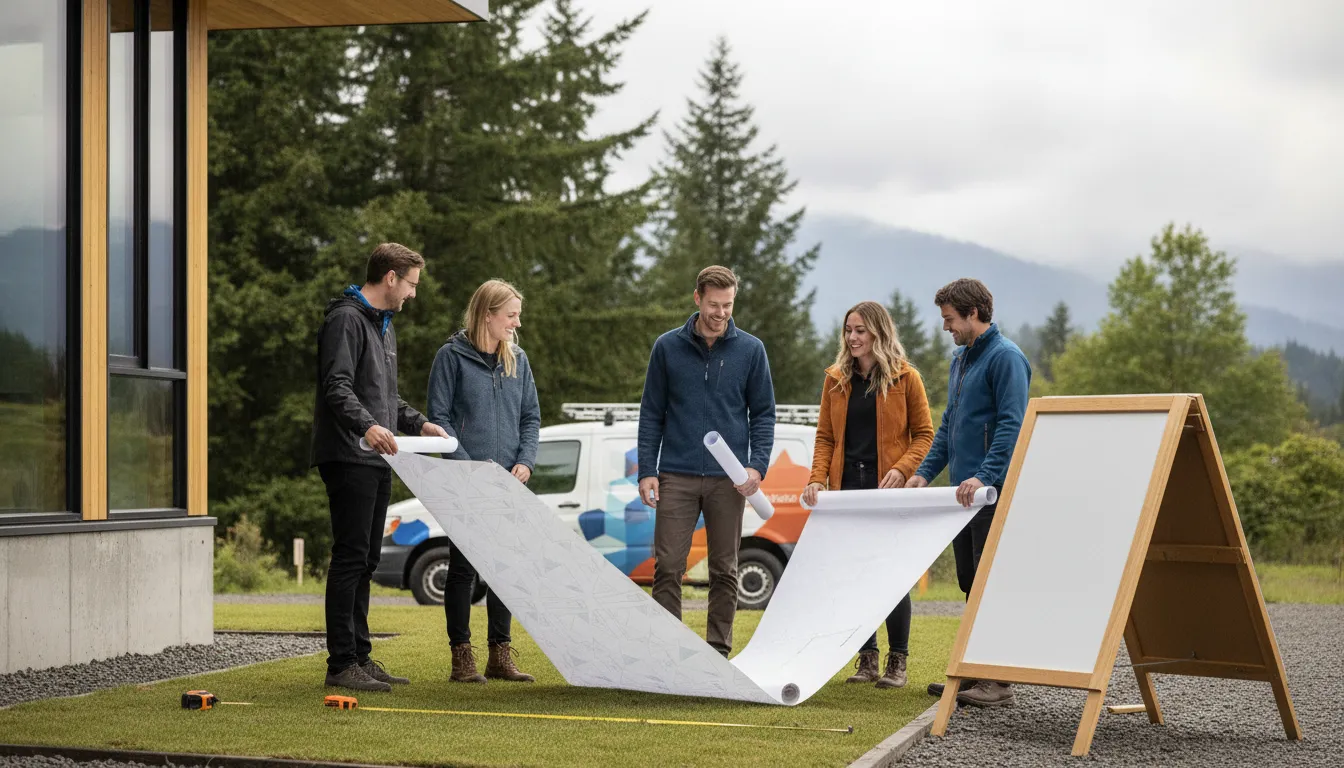
Real estate visibility is easier to manage when every public-facing graphic supports the same campaign instead of being ordered as a series of disconnected items. A property launch may need roadside identification, tenant-facing window graphics, neighborhood banners, and branded vehicle graphics, each adapted to its setting while sharing the same visual system.
Real estate marketing materials printing works best as a coordinated plan for signs, banners, window graphics, and vehicle graphics, with formats, quantities, installation needs, and timing selected around each property’s goals.
For teams across Portland and the surrounding metro, APM PrintWorks provides local planning support from its Beaverton base. The right starting point is to clarify what this broader service includes and how it differs from ordering one isolated sign.
What Is Real Estate Marketing Materials Printing?
Real estate marketing materials printing is the coordinated planning and production of large-format visibility assets for properties, developments, brokerages, and real estate teams. Instead of treating each item as a separate order, the team plans how signs, banners, window graphics, and vehicle graphics will work together across listings, offices, construction sites, open houses, and daily routes.
The goal is a consistent visual system. Shared colors, logo use, typography, imagery, and messaging help a property or real estate brand remain recognizable as people encounter it in different locations. The right mix depends on where the audience will see the message, how long the campaign will run, and whether the asset needs to move between properties.
This broader planning role is different from a sign-specific buying decision. The real estate sign printing guide covers the detailed considerations for ordering property signs. This article focuses on how signs fit into a wider campaign without repeating that buyer guidance.
- Signs: Property and directional signs provide location-based visibility where listings, developments, or offices need to be identified.
- Banners: Banners create prominent messages for launches, leasing activity, development sites, and temporary campaigns. Custom sizing can help the message fit the viewing distance and installation area.
- Window graphics: Window graphics turn office, leasing, and property-facing glass into branded space while accounting for visibility, daylight, and the way the window is used.
- Vehicle graphics: Wraps, spot graphics, decals, magnets, and fleet programs extend a real estate team’s presence beyond a single property.
APM PrintWorks plans these projects from its Beaverton location for businesses and organizations across the Greater Portland metro. A coordinated project starts with the intended audience and locations, then moves through design, material selection, production, and installation planning.
How Do You Build a Consistent Real Estate Visibility System?
Start with the identity you want people to recognize, then carry it across every place a prospect encounters the property or the team. A consistent system uses the same logo treatment, color palette, typography, image style, and core message on property signs, banners, window graphics, and vehicles. The result feels intentional rather than assembled one item at a time.
Dream: define the experience
In the Dream phase, identify the campaign’s job. A listing may need clear on-site direction, while a development may need broad visibility from a nearby road. A brokerage may want its agents and service vehicles to reinforce the same identity across multiple properties. Map the audience, viewing distance, traffic pattern, and property timeline before choosing formats. This keeps the visual system connected to how people will actually see it.
Plan: translate the identity into formats
Plan the elements that should stay consistent and the details that can change. A property name, contact action, and brand mark may remain fixed, while an address, availability message, or campaign image changes by location. Banners can support custom sizes, so review the available space and viewing distance before selecting a layout. Explore custom banner options with the same visual rules used elsewhere.
Window graphics should also account for sightlines, glass surfaces, and the balance between visibility and natural light. The team’s window graphics design guidance can help inform those decisions. For a portable property presence, APM describes yard signs as lightweight corrugated plastic signs with an H-stake. Vehicle graphics can extend the identity beyond a single site, with wraps available in permanent or temporary approaches when the project calls for them.
Create: produce a system that can repeat
In the Create phase, use approved artwork standards and a shared proofing process so each item looks like part of the same campaign. Confirm dimensions, materials, installation needs, and quantities together rather than treating every item as an isolated order. A Beaverton-based provider serving Greater Portland, APM PrintWorks can help coordinate the design and production conversation around the team’s actual locations and goals. Your vision is our mission, and the strongest real estate marketing materials printing plan makes every format reinforce the next.
Which Large-Format Materials Fit Each Property and Campaign?
The right mix depends on where people encounter the property, how long the campaign will remain in place, and whether the asset needs to move with the team. A coordinated plan can use several formats without making every location look identical. Start with the viewing distance, surface, access conditions, and expected changeover schedule, then select materials that support those conditions.
| Material | Best use | Planning question | Production or installation consideration |
|---|---|---|---|
| Yard signs | Identifying a listing, development, open house, or directional point from the roadside. | Where will the sign be seen, and does the placement need to change between properties? | Corrugated plastic is durable, lightweight, and portable. An H-stake can support ground placement, subject to site conditions and permission. |
| Banners | Making a larger property, construction, leasing, or event message visible across a facade, fence, or other approved span. | What viewing distance, mounting surface, dimensions, and wind exposure should the design accommodate? | Custom sizing may be available. Some applicable banner products can be produced seamlessly at substantial lengths, so the final size and mounting plan should be confirmed together. |
| Window graphics | Using storefront, leasing-office, or model-property glass to display branding, wayfinding, or a campaign message. | Should the graphic preserve visibility through the glass, provide privacy, or be removed for a later campaign? | Measure each pane, account for frames and access, and confirm the surface is suitable for the selected graphic and installation method. |
| Vehicle graphics | Extending a brokerage, property-management, or development campaign beyond one address through mobile visibility. | Will the vehicle need a permanent identity, a temporary campaign, or a repeatable treatment across a fleet? | Options include full or partial wraps, spot graphics, cut vinyl decals, and magnets. Design, vehicle condition, removal needs, and professional installation all affect the plan. |
These choices work best when the same core identity carries across color, logo placement, message hierarchy, and contact direction. A vehicle may need a shorter message than a banner, while a window graphic may prioritize readability from a nearby sidewalk. For more detail on mobile applications, review the vehicle wraps and graphics options before finalizing artwork. APM PrintWorks can help Portland-area teams coordinate the formats, surfaces, quantities, and installation requirements as one project rather than treating each property asset as an isolated order.
What Should You Prepare Before Requesting a Print Quote?
A useful quote starts with a clear picture of the project, not just a request for a product. Before contacting a printer, gather the details that affect visibility, production, installation, and scheduling. APM PrintWorks uses a collaborative Dream, Plan, Create process to understand the vision, assess the requirements, and develop the finished materials around the project.
- Define the audience and objective. Note who needs to see the materials and what they should understand or do. A listing launch, development announcement, leasing campaign, and brokerage identity may call for different messages, viewing distances, and formats.
- List every location. Provide property addresses, interior and exterior placement details, vehicle locations, and any locations that need matching materials. For a multi-property campaign, a consistent multi-location signage plan can help keep production and brand presentation organized.
- Record sizes and quantities. Estimate the dimensions of each sign, banner, window area, or vehicle surface, along with the number needed at each location. If measurements are not final, share photos, sketches, or site plans so the team can help identify the next measurement step.
- Gather artwork and brand direction. Include logos, colors, approved messaging, property photography, contact details, and any existing design files. Mention whether design support is needed or whether the supplied artwork is ready for production.
- Explain installation needs. Identify mounting surfaces, access limitations, installation heights, vehicle availability, removal requirements, and property permissions. These details help determine the appropriate materials and coordination plan.
- Set the campaign deadline. Share the launch date, property opening, listing schedule, or phased rollout dates. APM can then discuss the project sequence and confirm a realistic production and installation schedule rather than assuming a turnaround.
The more complete this information is, the more useful the quote conversation becomes. It gives APM’s team a practical foundation for moving from the initial Dream to a workable Plan and then into Create, with decisions tied to how each real estate campaign will be seen and used.
How Do Pricing and Turnaround Work for Real Estate Graphics?
There is no one-size-fits-all price for a coordinated real estate graphics project. APM PrintWorks prepares custom project quotes so the recommendation reflects what your campaign actually requires. Scope, finished size, selected materials, design needs, quantity, and installation can all affect the final quote.
For example, a single set of property graphics may involve different production choices than a rollout across several listings or offices. The visibility goal, mounting surface, location, quantity, and whether installation is included should be clear before the quote is finalized. Sharing those details early helps the team compare practical options instead of choosing materials based only on an initial estimate.
Timing is project-dependent as well. Artwork preparation, proofing, material selection, production, and installation coordination can each influence the schedule. APM PrintWorks is positioned around fast turnaround, but that positioning is not a guaranteed number of days for every product or project. Confirm the schedule early, especially when graphics must be ready for a property launch, open house, leasing push, or multi-location campaign. The Portland printing project timeline guide can help your team identify the planning details to discuss.
During the Dream, Plan, Create process, bring your target locations, approximate quantities, desired sizes, artwork status, installation needs, and launch date to the conversation. That gives APM PrintWorks, a Beaverton provider serving Greater Portland, the context needed to shape a useful quote and a realistic production plan.
What Should Portland Real Estate Teams Check Before Installation?
A strong installation starts with a site review, not a print file. Before production, confirm who owns or manages each property and whether the landlord, listing representative, municipality, or site manager must approve the placement. Record the approved locations, mounting method, and any restrictions on walls, windows, landscaping, vehicles, or shared entrances.
Review the site and the viewer’s perspective
Walk or photograph each location from the angles that matter. Check sightlines from approaching traffic and pedestrians, nearby trees, parked vehicles, lighting, and competing visual elements. Note surface condition, grade, wind exposure, moisture, and other weather or site conditions that could affect the installation. Confirm that installers can safely reach the area, park nearby, use required equipment, and work during an approved access window.
Approve the details before the crew arrives
Use one final proof for every format and location. Verify property names, contact details, URLs, colors, dimensions, placement, and the intended viewing distance. If multiple properties are involved, label proofs by site so a similar-looking design is not sent to the wrong address. Coordinate delivery, installation, removal, and any vehicle access with the listing team and property contact. APM PrintWorks is based in Beaverton and serves Portland-area businesses, so its local team can help align production and installation details across the metro without treating every site as identical.
Finally, review housing advertising language with the appropriate team before approval. The U.S. Department of Housing and Urban Development’s Fair Housing Act overview explains that fair-housing protections apply to housing-related activities, including advertising. This is a practical review reminder, not legal advice; escalate questions to qualified counsel or your compliance lead.
How Can a Team Turn One Design Into a Repeatable Campaign?
A strong campaign should not require a fresh design decision every time a property launches, an office opens, or a vehicle joins the fleet. Start by turning the approved concept into a compact brand system: define the logo placement, colors, type styles, photo treatment, contact details, calls to action, and required spacing. Keep those standards in a shared reference file that staff, agencies, and print partners can use.
Next, separate the campaign into planned phases. A team might begin with listing signs and window graphics, then add banners for a leasing push and vehicle graphics for agents or maintenance crews. Phasing lets you match production to property openings, available inventory, and confirmed locations instead of ordering every item at once. It also makes it easier to keep the same visual language across different materials and sizes.
Track assets like campaign inventory
Maintain a simple inventory with each asset’s location, format, quantity, installation status, date ordered, and condition. Record which version of the artwork was used and note when signs, banners, or graphics need replacement. This prevents duplicate orders and gives the team a clear view of what can be moved to the next listing or property.
Build in revision checkpoints
Review the system after the first proof, after the first installation, and before expanding to additional locations. Check legibility from the intended viewing distance, color consistency, mounting or installation details, and whether the message still fits the audience. Changes should be made to the master design standards, not improvised separately on every file.
APM PrintWorks can help Greater Portland teams plan a coordinated real estate marketing materials printing program from its Beaverton location. Local project conversations make it easier to align formats, quantities, production timing, and installation needs before the campaign grows.
Discuss your real estate graphics plan
Frequently Asked Questions
How much does real estate marketing materials printing cost?
There is no useful one-size-fits-all price because the scope changes with dimensions, materials, quantity, design, finishing, and installation. Ask for a project-specific quote that groups signs, banners, window graphics, or vehicle graphics into one plan so you can compare the full rollout rather than isolated unit prices.
How far in advance should I order real estate marketing materials?
Start with enough lead time for creative approval, proofing, production, and any installation or delivery coordination. A local printer can often help plan a fast turnaround, but the schedule depends on the mix of products and project scope. Share your launch date, locations, quantities, and artwork status at the quote stage.
Which materials work best for a new property launch?
Use the property and viewing conditions to guide the mix. Yard signs help identify a listing, banners create visibility at a distance, window graphics support vacant or active spaces, and vehicle graphics extend the campaign through daily travel. Consistent colors, logo treatment, contact details, and calls to action make the set feel intentional.
What real estate advertising language should I review before printing?
Review copy, imagery, and targeting language for fair-housing concerns before approving production. The U.S. Department of Housing and Urban Development explains the Fair Housing Act and protected categories. Have the responsible broker or compliance reviewer approve final wording before materials are printed or installed.
Ready to Plan Your Real Estate Graphics Project?
A coordinated set of signs, banners, window graphics, and vehicle graphics can help your properties present a clear, consistent message across the Portland metro. Share your locations, formats, artwork needs, and desired schedule so the project can be scoped around how each asset will be used.