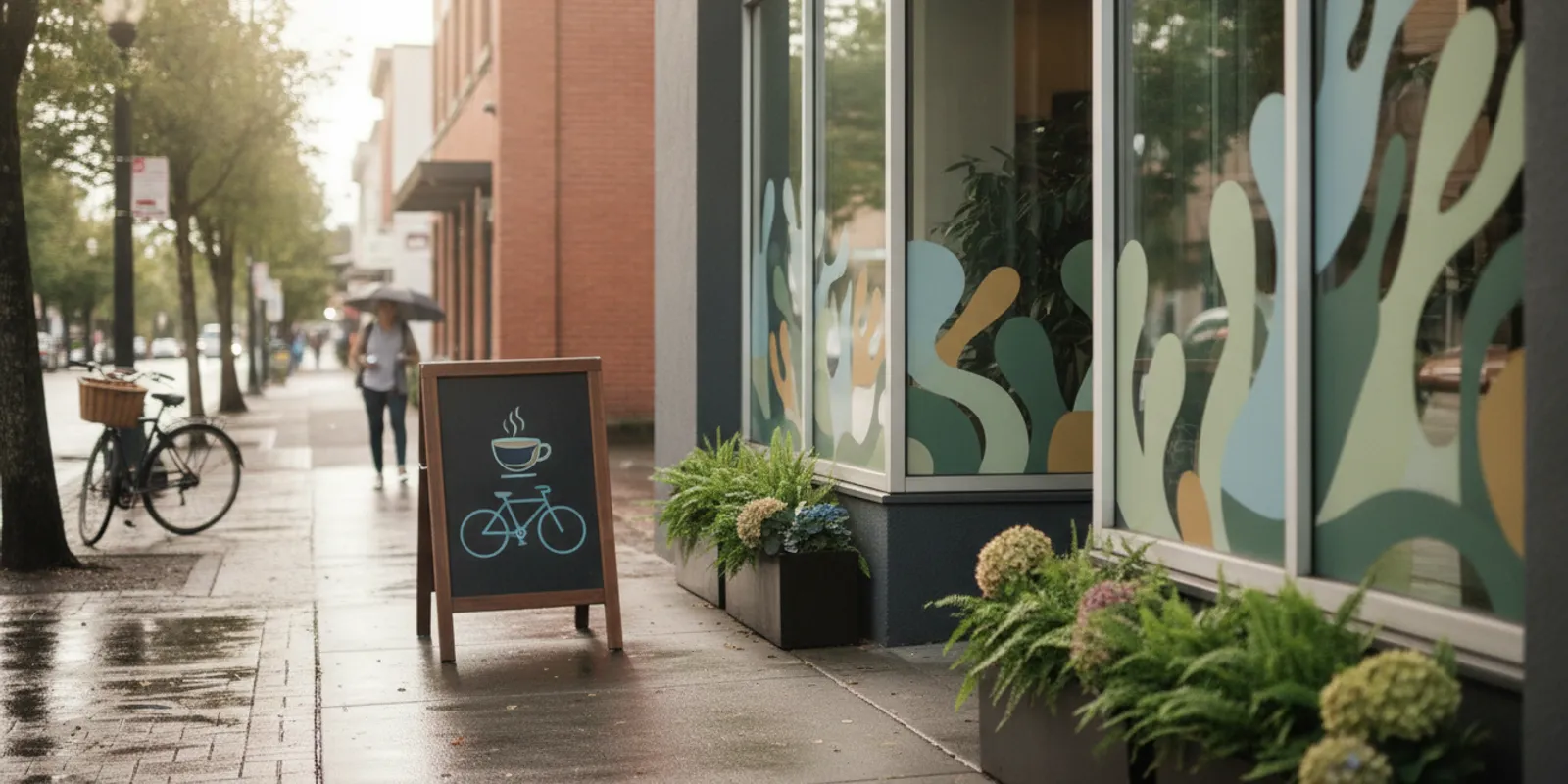
Collateral advertising works best when each physical piece supports the same campaign goal. For Portland-area businesses, that might mean coordinating a storefront sign, window graphics, event banners, vehicle graphics, or direct mail so a customer sees a clear and consistent message at useful moments. Before choosing materials, decide what the campaign needs to achieve and how people will encounter it.
Discuss your collateral advertising project
What does collateral advertising mean for a local business?
Collateral advertising is the use of tangible campaign materials to make an organization, offer, event, or service easier to notice and understand. It is not simply a list of printed items. It is a planned set of touchpoints that work together: one piece catches attention, another provides context, and a later interaction gives the audience a next step.
For example, a neighborhood retailer could use window graphics to signal a seasonal promotion, a sign near the entrance to direct visitors, and a banner to make the promotion visible from farther away. A service business could use vehicle graphics to build recognition across its service area, then use a site sign or direct mail to provide more specific information to nearby prospects. The format changes, but the identity and core message should feel connected.
This approach differs from ordering separate pieces whenever a need arises. A coordinated plan considers where people will see each piece, what they should understand at that point, and what action is appropriate. It also makes production planning easier because sizes, artwork, quantities, installation needs, and timing can be considered together.
What should you decide before choosing a format?
Start with the business problem, not the product name. A format is useful only if it reaches the intended audience in a suitable place and helps them take a next step. Write down the answers to these questions before comparing production options.
- Who needs to notice the campaign? Describe the audience in practical terms: current customers, nearby residents, event visitors, drivers, or people entering a particular site.
- Where will they encounter it? Identify the location and viewing conditions. A message viewed from a moving vehicle needs different scale and simplicity than one read at close range.
- What should they understand? Choose one primary message, such as the organization name, a service, an event date, or a directional cue. Supporting details should not compete with it.
- What should happen next? Decide whether the audience should visit, call, attend, ask for information, or recognize the brand later. Make that action obvious and realistic.
- How long should the piece remain useful? A short event window, a seasonal campaign, and an ongoing identification need can call for different material and update plans.
These answers help prevent a common planning problem: selecting a format because it is familiar, then trying to force the campaign message into it. They also give a print partner a clearer starting point for recommending size, material, and production details.
Which physical formats can support the campaign?
Choose each piece for its setting and role. Large-format printing can help make a message visible in a space, while other campaign tools can extend the message to a different place or moment. A coordinated set does not require every format; include only what supports the objective.
| Format | Useful role | Planning questions |
|---|---|---|
| Signs | Identify a location, guide visitors, or communicate a focused message at a site. | Where will the sign be placed? What viewing distance, mounting method, and exposure should the design account for? |
| Banners | Make an event, promotion, or announcement visible across a larger area. | Will it be indoors or outdoors? What dimensions and attachment points fit the location? |
| Window graphics | Use storefront glass for promotion, brand visibility, or information for people nearby. | Which panes are available? Should the view through the glass remain open? How will the graphic be installed and removed? |
| Vehicle graphics | Build recognition while a business vehicle is parked or moving through its service area. | Which vehicles are included? What coverage is needed, and how will the design adapt to different vehicle shapes? |
| Floor graphics | Draw attention to a message or help guide movement in an appropriate indoor setting. | What surface will receive the graphic? What are the site’s cleaning, traffic, and placement considerations? |
| Direct mail | Deliver a campaign message to a selected audience at a physical address. | Who is the intended recipient, what is the distribution plan, and how does the mail piece connect to other campaign materials? |
| Safety materials | Communicate practical instructions or reminders in a workplace or public-facing environment. | What information must be clear at a glance, and where will people need to see it? |
APM PrintWorks provides custom sign printing and banner printing, along with vehicle wraps and graphics. If glass is part of the plan, review the available window graphics options. Match the format to the campaign setting rather than adding pieces simply to make the package larger.
What could a coordinated plan look like?
A simple scenario makes the planning method easier to apply. Consider a Portland-area organization opening a new location. The goal is not to use every available format; it is to help people notice the opening, find the site, and understand what the organization offers. A window graphic can identify the new location, a sign can help visitors orient themselves, and a short direct-mail message can reach nearby households. Each piece has a different role, but the organization name and core visual treatment connect them.
For a community event, the plan might begin with a banner that announces the event in a high-visibility location. Site signs can then direct people toward the entrance or key areas. If vehicles are involved in outreach, graphics may reinforce recognition before and after the event. Decide which information is essential on every item, such as the event name, and which details belong only where they can be read clearly. Confirm dates and directions before approving production.
A service-area business might need more sustained visibility rather than a single launch moment. Vehicle graphics can build familiarity as vehicles travel between jobs, while a site sign identifies the business at its location. Window graphics can communicate services to passersby, and a direct-mail piece can focus on a particular neighborhood or offer. In this case, the useful planning question is how each exposure adds a new piece of information without changing the underlying identity.
These examples are starting points, not fixed packages. A business may need only one well-placed sign, or it may need several formats coordinated across locations. Keep the plan proportional to the goal, available budget, and time. Ask what each item contributes, and remove it from the scope if it does not help the audience notice, understand, find, or act on the message.
How do you make separate pieces feel like one campaign?
Consistency comes from repeating the right elements, not copying one layout onto every surface. A vehicle, a window, and a banner have different proportions and viewing conditions. Each needs a design adapted to its purpose, while the campaign still feels recognizable from one contact to the next.
Set a simple visual system
Agree on the organization name, logo treatment, color palette, type style, and any campaign-specific imagery. Identify which elements must remain consistent and which may change by format. Share existing brand files and approved artwork early, especially if several teams or locations will use the materials.
Keep the message hierarchy clear
Give each piece one main job. Put the most important information first, then add only the details needed in that setting. A person passing a storefront may have little time to read; someone standing near a sign can take in more detail. A design that tries to say everything on every item can weaken the main point.
Connect the audience journey
Think about sequence. A large banner could make an event visible; a sign could help attendees find the entrance; and a follow-up mail piece could invite them to a later event. For a service-area campaign, vehicle graphics can provide repeated recognition, while a nearby sign or a direct-mail piece can supply a more specific offer or instruction. The connection can be a shared name, visual treatment, message, or clearly stated next step.
Where appropriate, use a consistent web address or contact route so the audience knows where to go next. Keep information accurate and easy to update. If dates, phone details, or offers change, review every piece that carries them before the next production run.
What production details affect the result?
Good planning accounts for more than the artwork. A print project may depend on the surface, environment, dimensions, quantity, installation, and how long the material needs to serve its purpose. Bring those details into the discussion before finalizing a design or schedule.
- Location and conditions: Note whether the piece will be indoors or outdoors, exposed to weather, seen through glass, or installed on a surface with specific requirements.
- Measurements: Provide the usable area and any restrictions around doors, windows, fixtures, vehicle features, or mounting points. Photos of the location can help clarify the context.
- Quantity and distribution: Estimate how many pieces are needed, where they will go, and whether each location needs a variation. A complete quantity plan is more helpful than a guess.
- Artwork readiness: Share the best available logo and source files, brand guidance, message copy, and any required approvals. If the design is not final, state what still needs review.
- Installation: Identify who will install the pieces, whether professional installation is needed, and any access or site coordination requirements.
- Timing: Work backward from the date the materials must be ready. Include time for design decisions, proof review, production, delivery, and installation where applicable.
- Future changes: Flag information likely to change, such as event dates or a temporary offer. This can inform which elements are treated as reusable and which are campaign-specific.
For a multi-format project, ask for the pieces to be reviewed as a set. Check that the main message, spelling, contact details, colors, and required approvals align across versions. Review each proof at its intended size and in its intended context when possible; text that looks readable on a monitor may be difficult to take in from a distance.
How should you plan the budget and turnaround?
There is no useful one-size-fits-all price for collateral advertising. The total depends on the selected formats, dimensions, materials, quantities, design needs, finishing, delivery, and installation. A simple sign and a coordinated set of graphics for several locations have different scopes. Request a project-specific quote rather than relying on a generic estimate.
Turnaround also depends on the work involved and the production schedule. Design development, revisions, special materials, proof approvals, multiple versions, and installation coordination can affect the timeline. If there is a fixed launch or event date, share it at the start and ask which decisions or approvals need to happen by when. Do not treat a production estimate as a guaranteed delivery date unless that has been confirmed for the project.
To make a quote easier to prepare, organize the request around the following information:
- The campaign goal and intended audience.
- The formats under consideration and the role each one should play.
- Sizes, locations, quantities, and any known installation needs.
- Artwork status, message copy, and brand files.
- The required in-hand or installation date, plus any review deadlines.
- Budget parameters, if available, and which elements are essential versus optional.
If the scope is still taking shape, explain what is decided and what is open. A production partner can then discuss possible paths without assuming that every item or location is already set. APM PrintWorks uses a consultative Dream, Plan, Create approach to understand a project, assess needs and budget, and move into production. The about APM PrintWorks page provides more context on the company and its approach.
Why work with a local Portland print partner?
A local print partner can discuss the project in its real setting: a storefront, worksite, event location, or fleet operating in the Portland area. That is useful when dimensions, installation, or coordination across multiple formats matter. APM PrintWorks is based in Beaverton and serves businesses and organizations across the Greater Portland metropolitan area.
APM PrintWorks supports a range of large-format and advertising needs, including signs, banners, and vehicle graphics, as well as specialized campaign materials. For a larger installation, the company describes capabilities that include professional installation teams and projects that can extend beyond the local area. Project scope and logistics should be confirmed during planning.
Local support does not remove the need to plan ahead. Bring clear objectives and site details, allow time for proof review, and confirm the scope and timing with the provider. That gives both sides a more useful basis for discussing options and avoids making assumptions about materials, installation, or delivery.
See APM PrintWorks’ floor graphics and transit advertising capabilities for examples of distinct applications that may support a broader visibility plan. Choose a service based on the audience and setting, then ask how it could fit with the rest of the campaign.
What should you check before approving the project?
Before production begins, make a final review that covers both the individual pieces and the overall campaign. Assign one person to consolidate corrections where possible; multiple uncoordinated versions can create avoidable proof changes.
- Is the campaign objective still clear in each format?
- Are names, dates, contact information, and other factual details correct?
- Does each piece have one clear priority and an appropriate next step?
- Are sizes, quantities, locations, and installation responsibilities confirmed?
- Have all stakeholders approved the correct version of each design?
- Does the delivery or installation plan allow the materials to be ready when needed?
- Is there a plan to remove, update, or replace time-sensitive materials?
When a campaign includes specific claims about a product, service, offer, or savings, check that the wording is accurate and supportable. The Federal Trade Commission provides information about consumer protection and truth-in-advertising responsibilities for businesses.
After the campaign begins, evaluate whether each item served its intended role. Ask staff what questions they heard, note whether people could find or understand the information, and record any changes needed for the next run. These observations can guide the next project without requiring a complex measurement system.
Request a quote for your campaign materials
Frequently Asked Questions
Is collateral advertising only for large campaigns?
No. A small project can still benefit from coordination. Even two related pieces can share a visual identity and a clear message. The right scope depends on the audience, locations, and goal, not on the number of items.
Do all pieces need to use the same design?
They should feel connected, but they do not need identical layouts. Adapt the hierarchy and amount of detail to the viewing distance, format, and setting. Keep key brand elements consistent so the pieces are recognizable together.
When should I ask for a quote?
Ask once you can describe the goal, likely formats, approximate quantities, locations, and required date. If some details are undecided, say so. Sharing what is known helps the provider identify what information is still needed to define the scope.
Can one provider handle several kinds of graphics?
Capabilities vary by provider. APM PrintWorks offers a range of commercial printing solutions, including large-format graphics, signs, banners, and vehicle graphics. Contact the team with the project outline to discuss which parts fit its capabilities and what the production plan may involve.
How can I avoid delays?
Provide accurate measurements and artwork, name the final decision-maker, respond to proofs promptly, and communicate fixed dates early. Confirm the timeline and any installation coordination directly with the print provider before committing to a launch plan.
Ready to plan collateral advertising?
Start a conversation about your print project
A clear goal, a connected set of materials, and a realistic production plan can help your campaign show up consistently across the places your audience encounters it. APM PrintWorks is Portland’s local printer for businesses and organizations planning custom print and large-format projects.