
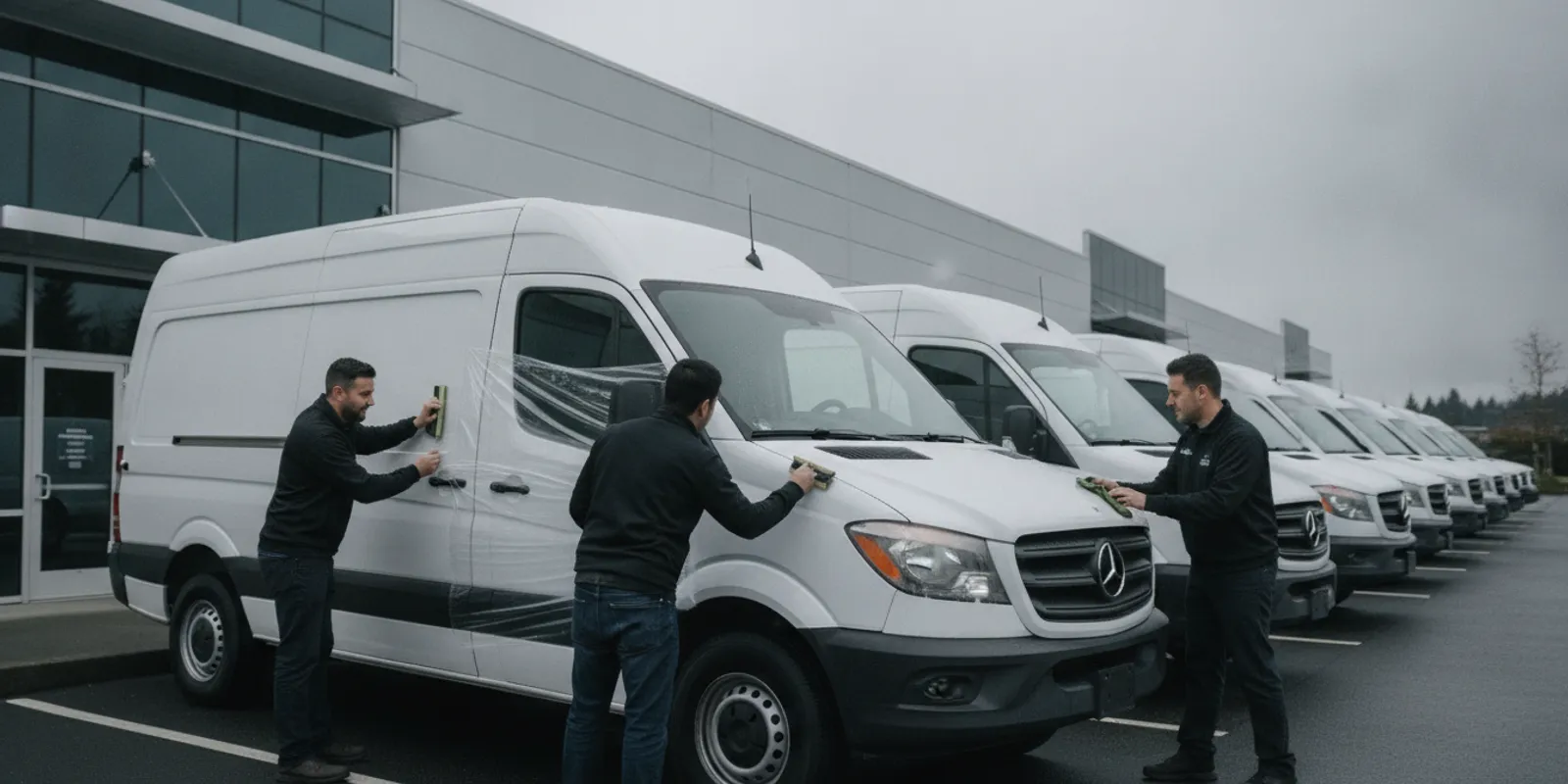
Commercial vehicle wraps can make a growing service fleet look consistent and help customers recognize your vehicles. The challenge is getting the work done without taking every vehicle out of service at once. A practical schedule starts with your operating calendar, not the installer’s first available date. Map vehicle availability, daily routes, design approvals, and installation capacity before committing to a rollout.
Plan your fleet wrap project with APM PrintWorks
What makes a fleet wrap schedule different from a single-vehicle project?
A single vehicle may be easy to remove from service for a planned window. A fleet is different: each vehicle could have a route, assigned crew, equipment, or customer commitments that are difficult to shift. If several vehicles are unavailable together, the effect can reach dispatch, staffing, service appointments, and response coverage.
That is why a rollout needs both a production plan and an operations plan. The production plan covers artwork, proofs, materials, preparation, and installation. The operations plan covers which vehicle can be spared, what work it normally handles, who can use a replacement, and how the next vehicle’s slot will be confirmed.
Start by defining the outcome. Are you wrapping all vehicles in one coordinated visual system, introducing new graphics as vehicles are replaced, or updating only a subset? A clear scope helps you select a workable order instead of trying to fit the entire fleet into one large installation window.
How do you inventory the fleet before choosing dates?
Build one working list of vehicles and the facts that affect their availability. Include the unit identifier, vehicle type, primary use, normal operating days, route or territory, assigned team, and any known maintenance or replacement dates. Note whether the vehicle has special equipment or a configuration that could affect artwork or installation planning.
Then identify the operational cost of taking each unit out of rotation. A vehicle that can be covered by another team may be a better early candidate than one that supports a time-sensitive or specialized service. Ask dispatch and team leads to review the list; they often know about recurring busy periods or route constraints that a central calendar will not show.
- Mark essential units. Flag vehicles that cannot be readily substituted.
- Identify flexible units. Note vehicles with lighter schedules, spare capacity, or planned downtime.
- Check the calendar. Record seasonal peaks, known contracts, staff leave, planned maintenance, and vehicle deliveries.
- Confirm the real owner. Name the person who can approve each vehicle’s release and return to service.
Keep the inventory current as the project develops. A calendar based on last month’s routes can become unreliable when jobs, staffing, or vehicle availability change. Agree on a regular check-in with the person who manages dispatch so the installation sequence reflects current operations.
Which rollout pattern fits your operation?
There is no single rollout pattern that works for every company. The right choice depends on how interchangeable the vehicles are, how far they travel, and how quickly the business needs a consistent appearance. Use the table as a starting point, then adjust each option to your actual staffing and production capacity.
| Scheduling approach | How it works | Works well when | Main consideration |
|---|---|---|---|
| One vehicle at a time | Release a unit, complete its installation, check it, then release the next. | Routes depend on specific vehicles or replacement capacity is limited. | More calendar coordination may be needed across the rollout. |
| Small, staggered batches | Wrap a limited group during a planned low-demand window, then repeat. | Some units can be covered by remaining vehicles or temporary reassignment. | Confirm that the available fleet can still meet expected workload. |
| Vehicle-type grouping | Schedule similar vehicle bodies or configurations together. | Artwork and installation details are similar across a group. | Do not group units together if doing so leaves a service gap. |
| Replacement-cycle rollout | Apply the design as vehicles enter service or reach a planned refresh point. | Fleet changes happen over time and a gradual transition is acceptable. | Older and newer graphics may appear together temporarily. |
| Single coordinated window | Bring multiple units in during a shared shutdown or low-use period. | The business has a genuine fleet-wide pause or adequate substitute capacity. | Requires careful staffing, access, and readiness coordination. |
For many growing service companies, one vehicle at a time or small staggered batches provide a useful starting point. These approaches make it easier to learn from the first installation, resolve practical issues, and refine the next appointment. If a consistent reveal date matters, a coordinated window can work, but only when business coverage is clear and the installation plan is confirmed in advance.
How should you choose the first vehicles?
Do not automatically start with the newest, largest, or most visible unit. Choose a first vehicle that is representative enough to test the plan but operationally flexible enough to release without creating a service problem. It should also be in suitable condition for the planned work, with its body configuration and surface details understood before the appointment.
Some companies begin with a lower-demand unit to test scheduling, handoff, and return-to-service procedures. Others choose a frequently seen vehicle because it gives the team an early chance to evaluate the design in use. Either way, select deliberately and agree on what you will review after the first vehicle is complete.
- Was the vehicle released and returned at the times agreed?
- Did its usual work transfer smoothly to another unit or team?
- Did the approved artwork match the vehicle’s actual configuration?
- Were the handoff, inspection, and internal communications clear?
- What needs to change before the next vehicle is scheduled?
Use those observations to improve the remaining sequence. A short review after the pilot can prevent the same avoidable scheduling problem from repeating across the fleet.
What should be ready before you reserve an installation slot?
Installation dates are easier to coordinate when decisions and vehicle details are ready beforehand. Gather the information needed to develop and approve the design, including the number and types of vehicles, photographs or references when useful, brand assets, required messages, and any differences between vehicle units. Confirm who has final approval so feedback does not sit with several people and delay the schedule.
Review each vehicle’s condition and configuration with the production team. Existing graphics, repairs, surface condition, trim, handles, windows, and body variations may affect design placement or preparation. Do not assume that two vehicles with the same general model name are identical for artwork purposes. Provide accurate references and ask what details need confirmation before proof approval.
APM PrintWorks provides vehicle wraps and custom graphics; discuss the fleet, intended use, and rollout plan so the project can be scoped around the vehicles involved. A company with varied vehicle types may also benefit from reviewing its broader creative and design support as it develops a consistent visual system.
Before the schedule is considered firm, agree on these points:
- Approved scope: Which units are included now, and which are planned for a later phase?
- Artwork approval: Who reviews the proof, and how will vehicle-specific changes be handled?
- Vehicle readiness: What cleaning, access, or preparation is expected before handoff?
- Appointment ownership: Who confirms the drop-off and pickup arrangements?
- Change process: Who must be notified if a vehicle, route, or date changes?
How can dispatch protect daily operations during the rollout?
Give dispatch a schedule they can use, not just a list of target dates. For each vehicle, show its normal assignment, installation window, backup plan, and the person responsible for confirming availability. Share the schedule with affected team leads and drivers early enough for them to plan, then reconfirm the next unit before it is released.
Build flexibility into the sequence. Avoid placing every appointment on the same critical operating day or assuming a vehicle will be available just because the calendar says it is. Leave room to respond to a changed route, a service emergency, a delayed approval, or a vehicle that is not ready. If a slot has to move, the team should know whether the next unit can advance or whether the project should pause.
Set up a simple status tracker with practical stages such as “information needed,” “proof in review,” “approved,” “appointment confirmed,” “in production,” and “returned to service.” Assign one owner to update it. This gives managers a shared view of progress without relying on informal messages or assumptions.
Tell drivers and crews what to expect. Explain where to bring the vehicle, what should be removed from the cab or cargo area, who handles keys, and whom to contact if the vehicle’s condition or schedule changes. Keep instructions consistent for every unit, while noting any unit-specific differences.
How should you plan around vehicle condition and compliance?
Vehicle readiness affects both timing and the quality of the finished work. Before an appointment, confirm the expected condition with the installer. Ask whether the vehicle should arrive clean and dry, whether existing graphics need to be discussed, and whether damage or recent repairs need review. If the vehicle is not in the expected condition, contact the project team before sending it in so the next step can be agreed instead of guessed at during the appointment.
Check the vehicle’s equipment and operating requirements before artwork is approved. Ensure that required lights, windows, plates, mirrors, markings, and safety-related visibility are not obscured or compromised by the proposed layout. Requirements can differ by vehicle and use, so have the appropriate fleet or compliance manager review the design where needed. For fleets operating regulated commercial motor vehicles, consult your compliance lead and the relevant requirements; the Federal Motor Carrier Safety Administration is a starting point for federal carrier safety information. This general planning guide is not a substitute for checking rules that apply to a specific vehicle or operation.
Include the review in the project calendar rather than treating it as a last-minute check. If a design needs revision, the team can update the proof before production and avoid disrupting an installation slot that was reserved for an unapproved layout.
What if your fleet is still growing?
A growing fleet may change while the first group is being planned. New vehicles can arrive in different configurations, hiring may shift route coverage, and a new service area may change which units are most visible. Decide whether the immediate goal is a complete fleet refresh or a repeatable standard for vehicles joining the fleet over time.
If vehicles will be added gradually, document the approved design system and the information needed to apply it to a new unit. Keep a record of the artwork version, vehicle configuration, placement decisions, and approval owner. This helps preserve consistency as the business grows, while still allowing the design to be adapted to a different body type when appropriate.
For a mixed fleet, list the vehicle types and their quantities before finalizing the scope. A company using vans, trucks, or specialty vehicles may need separate proofs or variations. The fleet vehicle graphics planning guide can help you think through a broader fleet rollout, while the food truck wrap ideas article offers a related example of planning graphics for a specific vehicle use.
Agree on how long it is acceptable for the fleet to show a mix of old and new graphics. If the transition needs to be brief, prioritize vehicles by customer visibility or route importance, while preserving enough capacity to serve customers. If a gradual update is acceptable, schedule each new or replacement vehicle as its availability and readiness are confirmed.
How do you coordinate the schedule with the print and installation team?
Share the operational facts early: the number of units, vehicle types, location, preferred sequence, periods when vehicles are unavailable, and any deadlines that affect the rollout. Ask what information the production team needs before confirming dates, and clarify how long each appointment is expected to occupy a vehicle. Do not convert an estimate into a guaranteed return time unless the project team has confirmed it.
Discuss practical logistics as well. Confirm where each vehicle should be dropped off, who can authorize work, how access will be arranged, and how pickup will be confirmed. If units are spread across locations, identify whether they can be brought to one place or whether a different coordination plan is needed. A local provider can be useful when a fleet manager wants to discuss production details directly; APM PrintWorks serves businesses in the Greater Portland area from Beaverton.
Keep one communication channel for schedule changes. If a unit becomes unavailable, notify both dispatch and the project contact as soon as possible. Confirm the revised plan in writing, including which vehicle is next and whether the change affects any other appointment. That simple habit avoids two teams working from different versions of the calendar.
What should you inspect when each vehicle returns?
Build a brief return-to-service check into the schedule. Inspect the finished vehicle with the appropriate project contact, compare the result with the approved proof, and note any questions before the unit returns to its normal assignment. Confirm that the driver or fleet manager knows any care or use instructions provided for the finished graphics.
Record the completion date and vehicle identifier. If the project covers multiple units, this creates a clear record of which vehicles are finished and which remain. It also helps the company coordinate future additions or updates using the same approved reference.
Keep the check focused and consistent. A repeatable process reduces the chance that an issue is overlooked on a busy return day and helps the next appointment follow a known handoff routine.
What should a fleet wrap planning checklist include?
Before the first vehicle is scheduled, bring the key decisions together in one place. Use this list during a planning meeting with operations, dispatch, marketing, and the print provider:
- Fleet inventory with vehicle types, identifiers, and primary assignments.
- Priority and flexibility notes for each vehicle, including planned maintenance or replacement.
- Known busy seasons, route constraints, staffing gaps, and business deadlines.
- Rollout approach: one at a time, staggered batches, vehicle-type groups, or phased additions.
- Approved design scope, artwork owner, proof reviewers, and revision process.
- Readiness expectations and details that may affect the design or installation plan.
- Drop-off, pickup, key handoff, and return-to-service responsibilities.
- A backup plan for a changed route, unavailable unit, or shifted appointment.
- A shared tracker and a named owner for updates and confirmations.
Once these decisions are documented, compare the proposed sequence against actual service coverage. If releasing a vehicle leaves a route without a workable replacement, change the sequence before reserving the slot. This check is more useful than creating a compressed schedule that looks efficient on paper but is difficult to operate.
Discuss a practical fleet rollout plan
Frequently Asked Questions
Should a growing company wrap every vehicle at the same time?
Not necessarily. A single coordinated window can work when the company has a real pause in operations or enough replacement capacity. If vehicles are essential to daily routes, a one-at-a-time or staggered rollout is often easier to coordinate. Choose based on coverage and availability rather than appearance alone.
Can the first vehicle serve as a pilot?
Yes. A first unit can help the team test the artwork approval, handoff, and return-to-service process. Choose a representative vehicle that can be released without creating a service gap, then review what worked before confirming the next appointment.
When should artwork and vehicle details be finalized?
Resolve the design, vehicle configuration details, approval responsibilities, and readiness questions before treating an installation date as firm. If the fleet includes different body types or configurations, provide the relevant references and confirm whether separate proof variations are needed.
What if an assigned vehicle becomes unavailable on its scheduled date?
Tell dispatch and the project contact as soon as the change is known. Use the agreed backup plan to decide whether another ready vehicle can take the slot or whether the appointment should move. Confirm the revised sequence so the rest of the fleet plan stays accurate.
How can a local business start planning its fleet project?
Gather a current vehicle inventory, operating constraints, and the desired rollout outcome, then discuss the project scope and design process with a local provider. APM PrintWorks is a Portland-area printer based in Beaverton, and its team can discuss commercial vehicle graphics and project coordination with businesses in the region.
Plan your next step
When operations, artwork, and vehicle readiness are planned together, a fleet wrap rollout is easier to manage than when dates are chosen one vehicle at a time without a shared process. APM PrintWorks is a local Portland-area printing partner for businesses planning commercial vehicle graphics; use the contact page to share your fleet details and discuss a practical sequence.
Share your fleet project with APM PrintWorks
A clear inventory, named schedule owner, and flexible rollout sequence give your team a useful foundation for keeping vehicles working while the fleet’s new look comes together.