Custom fabric banners can be a strong choice when a business needs a polished display for an indoor campaign or a location protected from direct weather. The best fit depends on viewing distance, lighting, installation, reuse plans, and exposure to wind or moisture—not simply on how the material looks in a sample.
When are custom fabric banners a good fit?
Fabric banners are worth considering when you want a softer, less reflective appearance than many rigid or coated display options. They can suit indoor brand backdrops, reception areas, temporary event environments, and sheltered campaign spaces where a lightweight hanging display is useful. The right choice depends on the actual conditions and what the banner must communicate.
Think of the banner as one part of a display system. The graphic, mounting method, light, viewing angle, and surrounding activity all affect the result. A fabric banner behind a registration desk may need a refined appearance at close range. A banner high on a wall may need larger shapes and fewer details because people see it from farther away.
For a local project, APM PrintWorks is a Portland-area printer based in Beaverton, serving businesses and organizations across Greater Portland. Its banner printing services offer a relevant starting point for discussing format and project requirements.
Fabric is not automatically the answer for every indoor display, and a sheltered outdoor location still has risks. Decide what matters most before requesting a quote: a low-glare appearance, portability, repeated use, a particular size, or compatibility with an existing display structure.
Where will the banner be displayed?
Location is the first decision because performance depends on the environment. Indoor use generally gives you more control over wind, rain, and direct sunlight. A covered outdoor location can still experience gusts, damp air, changing temperatures, or sunlight at an angle. Do not treat “sheltered” as the same as fully protected.
- Interior wall or backdrop: Consider viewing distance, ambient light, mounting surface, and whether visitors see it straight on or from an angle.
- Covered entry or patio: Check for wind tunnels, rain blow-in, direct sun, and nearby traffic that could affect stability or visibility.
- Temporary venue: Confirm where the display can be installed, how long it will remain, and whether venue rules restrict attachment methods.
- Repeated campaign use: Plan how the banner will be removed, protected, stored, and transported between uses.
Do a simple site walk before choosing a format. Stand where the intended audience will approach from. Note the closest and farthest viewing points, direction of light, competing signs, and any doors or equipment that could block the graphic. Photograph the location and measure usable width and height, including clearance for the support system. Measure more than once, and note whether the surface is level or whether a beam, railing, or fixture interrupts the space.
For outdoor exposure, write down what “covered” means at that specific site. Is the display under a deep roof, or near an open edge where wind and rain reach it? Does sunlight fall on it for part of the day? Could people bump or pull on it? Those details matter when selecting material and attachment. If airflow is a consideration, a mesh banner may be a relevant alternative; the best fit still depends on location and installation. APM also discusses pole banners for settings where that format is suitable.
Consider the audience’s path, too. A display viewed while people walk past has less time to communicate than one facing a seated audience. Note whether viewers will approach from both directions. If the banner must be seen from several angles, discuss how it will hang and whether the artwork needs to work from each approach. A site plan or a few phone photographs can make these details easier to explain.
What should you compare before choosing a banner?
Compare options against actual conditions and intended use, not just the material name. A sample that looks attractive in a controlled room may not be the right answer for a windy location or a display intended to be viewed across a large space. Ask the printer to clarify available construction and finishing choices for your application. This overview of custom fabric banner formats discusses examples of banner configurations; use it as a prompt for questions rather than a substitute for project-specific advice.
| Planning factor | Fabric banner consideration | What to confirm |
|---|---|---|
| Environment | Often most straightforward indoors or in a genuinely sheltered location | Wind, moisture, sun exposure, and expected display duration |
| Viewing conditions | Surface appearance, light, and angle affect perceived color and legibility | Viewing distance, light source, and audience approach |
| Message | Concise, high-priority elements are easier to take in at a glance | Finished dimensions, safe margins, and image quality |
| Installation | Attachment and support depend on banner design and venue | Mounting surface, hardware, venue rules, and installer responsibility |
| Reuse | Handling, cleaning, and storage influence condition over time | Transport method, storage space, care guidance, and reuse schedule |
| Alternatives | Another banner material or display format may fit better | Whether an alternate banner, sign, or graphic is more suitable |
Use the comparison to separate requirements from preferences. “Must fit the existing frame” is a requirement. “Prefer a softer look” is a preference. “May be reused next year” is a possibility that needs a storage and care plan. Making these distinctions helps the printer recommend a practical route instead of guessing which feature matters most.
A useful comparison starts by identifying what cannot change. Existing frame dimensions, venue restrictions, a fixed installation date, and a campaign message are constraints. Appearance, portability, and future reuse may be priorities but can sometimes be adjusted. If two options seem equally attractive, decide which one reduces the largest project risk. For example, if the display is near an open entrance, exposure and secure installation deserve more attention than easy storage.
How should you plan the message and artwork?
Start by deciding what one action or idea the display should communicate. A banner is not a page of copy. Give the main message visual priority, then include only supporting information a person can read from the expected distance. If viewers have only a moment to notice it, one clear idea will usually serve better than a long list of details.
- Set viewing distance. A backdrop viewed from a few feet away can carry more detail than a banner meant to be recognized across a large room. Judge type size and image detail from the farthest likely viewing point.
- Build a hierarchy. Make the principal message or identity element dominant. Keep secondary information visibly subordinate, and avoid giving every element equal emphasis.
- Check contrast. Review text and background in the lighting conditions where the banner will appear. Color combinations that look distinct on a bright monitor may be harder to distinguish in a dim room or under strong overhead lights.
- Keep key content clear of edges. Leave room for finishing and attachment. Ask the printer to confirm safe areas, especially if the design includes a border, small text, or important details near the perimeter.
- Send appropriate files. Provide finished dimensions and original artwork where available. Ask for a review of image quality, proportions, and other production concerns before approval.
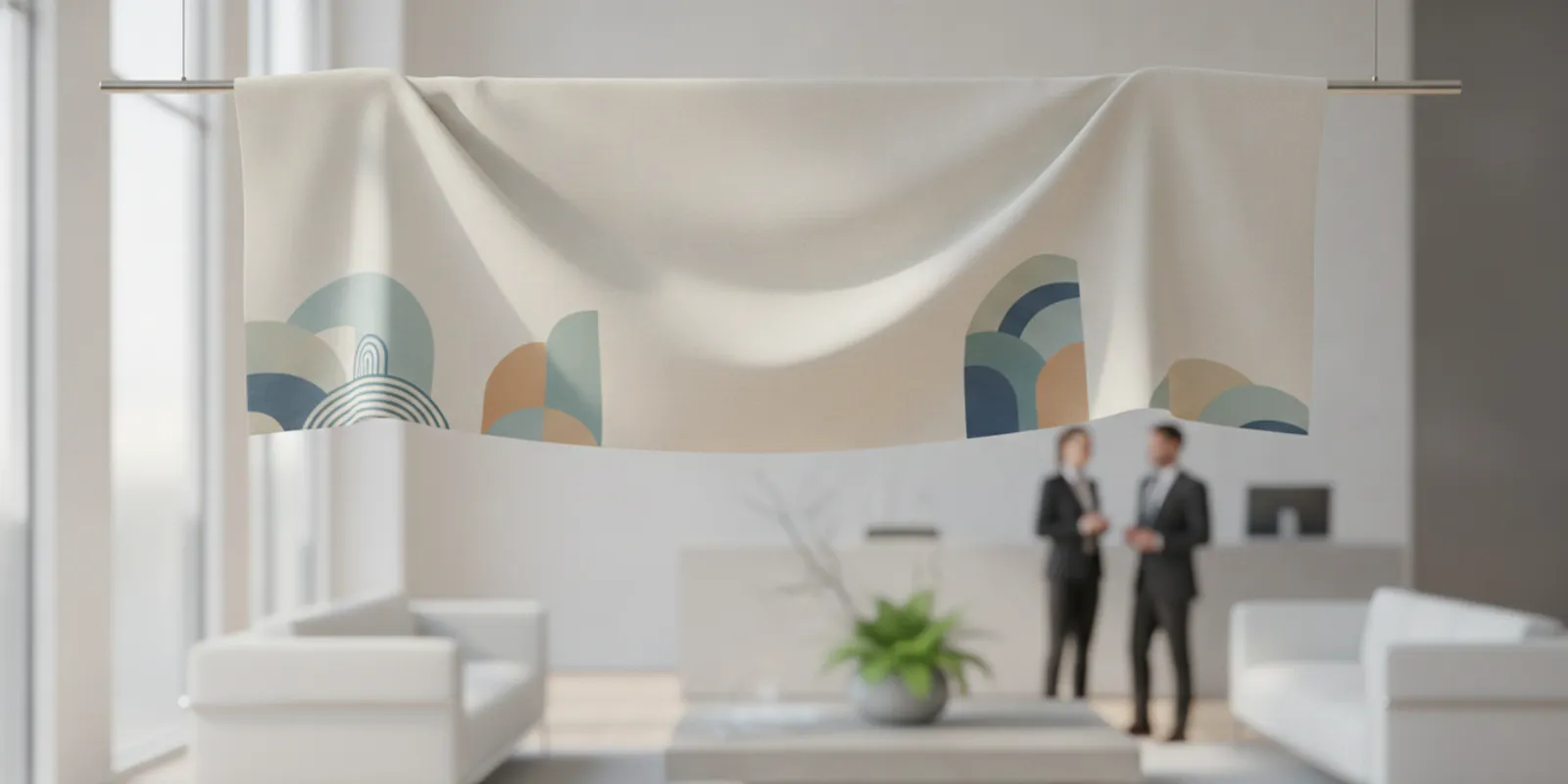
For example, imagine a business placing a backdrop behind a reception desk. The room has a bright window on one side, and visitors approach from a corridor. A useful design would make the organization’s name or campaign message readable from that corridor, keep smaller details away from the edges, and avoid relying on subtle color differences that could disappear in the window light. A proof review can reveal issues before the final production decision.
Do not approve a proof based only on how it appears on a phone. Review the layout at a useful scale and check spelling, colors, proportions, and the position of every key element. Confirm the final size and orientation against the real location. A mismatch between a design file and the available mounting area can waste time even when the artwork itself is well prepared. APM’s creative services team can be a resource when a design needs development or preparation.
For a large display, check how the composition reads at both near and far distances. A close viewer may notice a small line of supporting copy, but that does not mean it will be useful across a room. Ask someone who has not worked on the design to look at it briefly from the intended viewing point and describe its main message. If they focus on a minor detail, the hierarchy may need revision.
How do installation and reuse affect the decision?
Installation should be part of the specification, not an afterthought. A fabric banner may be suspended, attached to a display structure, or used with a suitable support system, depending on design and location. Confirm what the venue permits and whether the attachment method will keep the graphic positioned as intended. Do not assume hardware used for another banner will work with this one.
For each potential mounting point, check what it is made of, how much usable space is available, and whether access equipment or venue approval is needed. If the banner must hang above people or near a walkway, coordinate the installation method with the responsible venue or facilities contact. The printer can discuss production requirements, but the site owner or event organizer should resolve access and permission questions.
For a recurring campaign, map the full lifecycle: unpacking, installation, removal, storage, transport, and reuse. Assign responsibility for each step. Protect the printed surface from sharp objects, avoid storing it while damp, and follow care instructions for the specific material and construction. Do not assume every fabric can be cleaned or folded in the same way. If the banner will be moved often, include that handling pattern in the initial project discussion.
Think through a simple reuse scenario. A team uses the graphic for a seasonal display, removes it after the campaign, and stores it until the next cycle. Who will take it down? Where can it be kept clean and dry? Is there enough room to store it without crushing or creasing it? Will the message still be accurate next time? If the text has a date or a short-lived promotion, reuse may not be practical even if the physical banner remains in good condition.
When comparing alternatives, consider the entire setup. A banner that is easy to transport may still need a separate support. A rigid sign may offer a different kind of stability but take more space to move. If the campaign calls for graphics across a floor, window, or wall instead of a hanging banner, consider formats such as window graphics or wall displays.
How do you match the format to the campaign?
Write a short use brief before deciding. Include the campaign purpose, audience, location, duration, viewing distance, and whether the display needs to move. Then test the proposed banner against that brief. For a temporary indoor backdrop, the priorities might be a clean presentation, dimensions that fit the assigned space, and an installation that the venue permits. For a covered entry, exposure and secure mounting may become more important than portability.
Consider three practical scenarios:
- Lobby announcement: Visitors move through the space at varying distances. Use a short message with a clear focal point, check reflections and windows, and ensure the banner does not obstruct reception activity or sightlines.
- Community event backdrop: People may stand in front of the banner for photographs. Plan the visible area around people and furniture, keep essential artwork away from likely obstruction, and confirm how the venue will support it.
- Covered seasonal display: Weather exposure may be reduced but not eliminated. Inspect the open edges and likely wind direction, determine how long it will remain, and ask whether another material or format is more appropriate.
These cases show why a generic “indoor” or “outdoor” label is not enough. The real questions are what the graphic encounters, how long it stays in place, and what failure would mean for the campaign. A display inside a bright glass atrium may face intense light; a banner below a deep canopy may still be affected by gusts. Describe the situation accurately so the product recommendation can address it.
Use a simple decision sequence: first rule out any option that cannot satisfy the site or venue requirements; next compare visibility and message needs; then consider transport and storage; finally review the artwork and production details. This sequence prevents a preference for a certain look from obscuring a practical issue such as inadequate mounting space or exposure to weather.
What should you ask when requesting a quote?
Custom banner pricing depends on project specifications, so share enough information for a useful recommendation. A focused request helps identify missing decisions before production planning begins. Include facts you already know and clearly label anything that remains undecided.
- Where will the banner be installed, and is the site indoors, covered, or exposed?
- What are the finished width and height, and how far away will viewers usually stand?
- How long will it be displayed, and is reuse expected?
- What artwork is ready, and does it need design or file preparation?
- How should it be mounted, and are there venue or building restrictions?
- Will it be moved or stored between uses? What care or storage constraints are known?
- Are related signs or graphics meant to share the same visual approach?
- What is the desired project date, and are there access or installation considerations?
If dimensions are not final, provide the space measurements and explain what limits them. If the artwork is not ready, describe the message and any brand elements available. If you do not know which material or finish fits, say so rather than selecting one by guesswork. The details give the printer a clearer basis for discussing options.
APM PrintWorks uses a consultative process to understand the project, plan an approach, and create printed work. If you are coordinating a broader visual campaign, its custom sign solutions may also help you consider related pieces. APM PrintWorks is Portland’s local printer, serving Greater Portland from Beaverton, so businesses and organizations can discuss site conditions and project details with a regional provider.
To make the first discussion useful, assemble the site measurements, a few photographs, the campaign message, the desired display period, and any artwork files. Add a note about what is still unknown. This gives the printer room to help resolve open choices instead of treating an early guess as a fixed specification. If several people approve the project, identify who can confirm the final dimensions, venue permissions, and proof.
What should you check before approving the proof?
A proof review is the last opportunity to catch avoidable errors before production. Use a checklist rather than relying on a quick glance. Confirm that the approved file reflects the final decisions about location, message, dimensions, and mounting.
- Verify the copy. Read every word, date, phone number, and address. Have another person review it when the message is important.
- Check dimensions and orientation. Compare the proof with the measured space and intended support. Make sure the width and height have not been reversed.
- Inspect hierarchy and legibility. Confirm the main message stands out and secondary information is appropriate for the viewing distance.
- Review margins and finishing. Ensure important content is clear of edges and anticipated attachment or finishing areas.
- Consider the actual light and background. Ask whether surrounding surfaces, windows, or illumination will reduce contrast.
- Confirm logistics. Align delivery, installation responsibility, venue access, and reuse plans with the project team.
Keep one approved proof as the shared reference for the people coordinating the project. If a change is needed after review, identify the exact text or artwork element and request an updated proof. This prevents an earlier version from being mistaken for the final approval. Check that any revised proof replaces the previous version in the team’s working files.
Request a banner project consultation
Frequently Asked Questions
Are fabric banners suitable for outdoor use?
They may suit some sheltered locations, but the exact material and construction should be matched to wind, moisture, sunlight, and display duration. Describe the site and how the banner will be installed before choosing a format.
Do fabric banners work in bright indoor spaces?
They can, but lighting and viewing angle affect how colors and details appear. Review the intended artwork and placement, and prioritize strong contrast and a simple message that can be seen from the expected distance.
Can a fabric banner be reused?
Reuse depends on construction, handling, storage, and care. Discuss how often it will be installed and transported, follow the printer’s guidance for protecting it, and check whether its message will remain current for future campaigns.
What should I provide for a banner quote?
Share the location, intended dimensions, artwork status, use period, mounting needs, desired timing, and any venue restrictions. If details are uncertain, explain what you know and ask which decisions need to be resolved.
Plan your next step
Tell APM PrintWorks about your banner project
With the site conditions, message, size, and installation plan clear, you can choose a banner format that serves the campaign and fits the way people will encounter it.