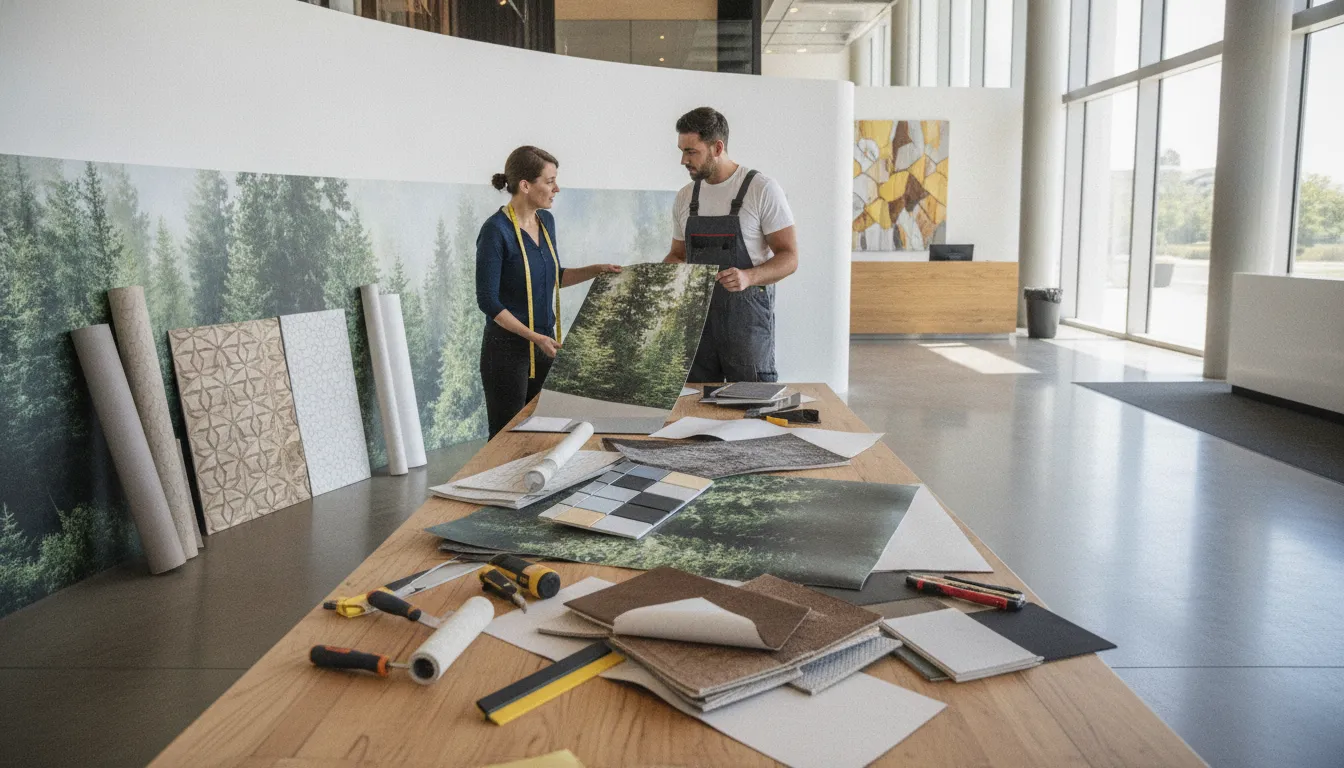
A branded wall can shape how customers, employees, and visitors experience a commercial space before anyone says a word. The right mural system should support the design, suit the wall, withstand the environment, and remain practical to install and maintain.
The best commercial wall mural materials depend on the surface, traffic level, desired texture, maintenance plan, and installation conditions. Wallpaper can create a polished, continuous finish, while textured wall decals offer conformability and visual dimension. A professional review helps match the material and laminate to the space instead of treating every wall the same.
APM PrintWorks serves businesses throughout Portland and Beaverton with custom commercial wall graphics and displays, coordinated from material selection through installation. Projects are quoted around the design and site requirements, with turnaround confirmed before production.
Talk with APM PrintWorks about your wall mural project.
Start by looking at what each material is designed to do, then weigh the demands of the room and the condition of the wall.
Understanding Commercial Wall Mural Materials
Material selection shapes more than the appearance of a branded interior. It affects how the mural applies to the wall, how it handles daily contact. Whether it can be removed cleanly, and how consistently the finished image supports the space. APM PrintWorks helps Portland-area businesses compare those tradeoffs as a creative partner, not simply select a substrate from a catalog. Explore our commercial wall graphics and displays for a broader look at large-format interior applications.
Printable wallpaper
Printable wallpaper is a strong fit when a business wants a continuous, immersive scene or a refined, room-scale pattern. It can give reception areas, hospitality spaces, offices, and retail interiors a finished architectural feel. Wallpaper is typically selected when the design should read as part of the room rather than as a separate applied graphic. The wall condition, installation method, and expected maintenance should be reviewed before production, especially where the surface receives regular contact or cleaning.
Self-adhesive vinyl
Self-adhesive vinyl offers flexibility for branded graphics that need efficient application, future replacement, or a more adaptable installation plan. Low-tack WallMark PS Vinyl is one example of a commercial wall-graphic material designed for easier application and removal in busy environments. It can also be trimmed to bleed, supporting a seamless edge-to-edge finish across the intended surface. The right adhesive still depends on the wall, paint condition, texture, and length of use. APM PrintWorks can help determine whether a low-tack or more durable construction is appropriate for the project.
Textured wall decals
Textured wall decals are made for situations where a standard smooth film would not adequately follow the surface. APM PrintWorks provides specialized durable, conformable adhesive vinyl for textured walls, along with component laminate options. That combination can help preserve the graphic while allowing it to conform to subtle wall irregularities. Texture also changes how light falls across the mural, so the proof should be reviewed at the actual viewing distance and under the room’s expected lighting. For projects where surface character is part of the design, textured wall decals may be the more practical direction.
As a local Portland printer serving Beaverton and the greater metropolitan area. APM PrintWorks reviews the wall, artwork, traffic level, installation requirements, and maintenance expectations before recommending a material. Wall murals are custom quoted based on size, complexity, material, finishing, and installation. Because those variables change the total, request a current project quote with a clear starting price or range rather than relying on a generic online figure. Turnaround is also project-specific, but APM will provide a defined production schedule after artwork approval and material selection, with fast turnaround available for qualified projects.
Wallpaper vs Textured Wall Decals for Commercial Spaces
Wallpaper and textured wall decals can both turn an ordinary commercial wall into a branded environment, but they are not interchangeable. The right choice depends on the wall condition, expected traffic, desired lifespan, and how often the space may need to change. APM PrintWorks helps Portland-area businesses compare commercial wall mural materials before production, so the finish supports the space instead of creating maintenance problems later.
| Consideration | Commercial wallpaper | Textured wall decals |
|---|---|---|
| Application | Installed in panels or strips with careful alignment, adhesive, and seam management. | Applied as a conformable adhesive graphic that can follow appropriate wall texture and contours. |
| Durability | A strong option for long-term interior branding when the specified substrate and finish suit the environment. | Durable adhesive vinyl, often paired with a component laminate, can provide resilience in demanding commercial spaces. |
| Removability | Removal may require more labor, particularly after extended installation or when adhesive bonds tightly to the wall. | Low-tack vinyl options can be easier to apply and remove, making them useful when branding may change. |
| Surface preparation | Usually requires a clean, smooth, sound surface for consistent seams and adhesion. | The wall still needs to be clean, stable, and compatible with the adhesive, even when the material is designed for texture. |
| Maintenance | Maintenance depends on the paper or vinyl construction, protective finish, and traffic level. | The selected laminate and texture should match expected cleaning, contact, and exposure conditions. |
| Cost | Project cost reflects material, panel count, wall preparation, installation complexity, and finishing. | Project cost reflects vinyl specification, laminate, wall condition, graphic size, and installation requirements. |
Surface preparation and installation are decisive
Neither material can compensate for a weak or unsuitable substrate. Dust, loose paint, moisture, uneven repairs, and incompatible coatings can affect adhesion and create visible defects. Material selection should account for the environment and the substrate so print quality holds up over time. For large walls, edges and seams also deserve attention. Commercial mural graphics can be trimmed to bleed, supporting a clean edge-to-edge application when the layout and installation plan are prepared correctly.
Professional installation is especially valuable when the wall is tall, textured, segmented, or located in a high-visibility lobby. An experienced installer can assess the surface, plan panel placement, manage seams, and reduce bubbles or misalignment. If the wall has meaningful texture or the project needs a removable branded treatment, review APM’s textured wall decals with the team before choosing a wallpaper specification.
APM PrintWorks serves Portland, Beaverton, and the surrounding metro area as a local creative partner. Because every project is custom quoted based on material, wall condition, size, and complexity, there is no responsible one-size-fits-all price range. Request a project quote for the actual surface and finish; turnaround is likewise confirmed with the proof. Material selection, and installation schedule rather than promised as a generic number.
How Surface Preparation Protects Your Wall Mural
A wall mural succeeds or fails partly before the first panel reaches the wall. Preparation determines whether the material bonds evenly, whether the artwork sits flat, and whether the finished installation looks intentional instead of fighting the surface beneath it. For a branded lobby, patient area, retail space, or office in Portland. That groundwork protects both the visual investment and the day-to-day experience of the people using the space.
- Assess the wall texture and condition. Start by examining the substrate in the actual installation area, not only in a sample room. Identify texture, paint sheen, seams, cracks, moisture concerns, dust, wall protection systems, and areas subject to unusual contact. Material selection must account for substrate compatibility with the environment so print quality remains consistent over time. Substrate compatibility is a core material consideration, particularly when a mural will live in a busy commercial interior.
- Repair, fill, and smooth imperfections. Patch holes, fill cracks, secure loose areas, and address visible transitions before printing is installed. Even a small ridge or depression can telegraph through a large graphic, interrupting lines in the artwork and creating a weak point at a seam. Allow repairs to cure fully, then sand them smooth and remove the resulting dust. If the wall has substantial texture or damage, a professional installer can recommend whether additional skim coating or a different mural material is appropriate.
- Clean the installation area thoroughly. Remove grease, dust, residue, and cleaning-product film with a method suitable for the existing paint or wall finish. The wall must be clean and completely dry before adhesive material is applied. Pay special attention to corners, base areas, door-side traffic zones, and places where furniture or equipment has rubbed against the wall. Preparation should also include moving or protecting nearby fixtures so the installation team can maintain a clean, controlled working area.
- Prime when the substrate calls for it. A compatible primer can create a more stable, uniform surface, especially where repairs, porous areas, or inconsistent paint finishes would otherwise affect adhesion. Primer is not a universal shortcut: the product, cure time, and finish need to match the selected mural system. Your printer and installer should review the wall condition together before specifying this step. That coordination helps avoid applying a premium graphic to a surface that is not ready to support it.
- Test adhesion before committing to the full mural. Apply a small sample in a representative area and observe how it bonds, conforms, and removes. Check edges, texture transitions, color appearance, and the effect of normal room conditions. A test can reveal problems while they are still inexpensive to correct, rather than after a full mural has been printed and scheduled for installation.
- Plan the installation sequence with a professional. Once the wall is approved, confirm panel order, artwork orientation, seams, trim, access, and protection for surrounding finishes. Commercial mural graphics can be trimmed to bleed for a seamless, edge-to-edge application, as reflected in the CDC environmental-graphics specifications. Professional installation matters because careful alignment, pressure control, edge treatment, and site handling are difficult to recover from once adhesive touches the wall. APM PrintWorks has professional installation teams available for wall graphics and serves businesses across Portland and Beaverton.
APM PrintWorks reviews the wall, artwork, and selected commercial wall mural materials as one project rather than treating preparation as an afterthought. Products are custom quoted based on material requirements and complexity, with turnaround confirmed during planning. That local coordination gives Portland-area teams a practical path from site assessment to a clean, durable finished mural.
Choosing Durable Commercial Wall Mural Materials for High-Traffic Lobbies
High-traffic lobbies need more than an attractive image. The wall mural material must withstand repeated contact from visitors, carts, furniture, cleaning routines, and everyday movement without quickly showing wear. That makes durability a design decision as much as a production decision. Mayo Clinic’s approach to commercial interiors emphasizes selecting materials and artwork purposefully, with attention to how they support the environment and remain meaningful over time. Thoughtful material selection and longevity matter when a graphic will greet people every day.
Start with contract-grade vinyl
For busy reception areas, corridors, healthcare facilities, offices, and retail entrances, Type II contract-grade vinyl is a strong starting point. It is designed for commercial interiors where surfaces face more use than a typical residential wall. The right specification balances image quality, dimensional stability, adhesion, and the conditions of the installation site. A material that performs well on a smooth, properly prepared wall may not be the best choice for masonry, lightly textured paint, or another irregular surface.
APM PrintWorks evaluates the wall and the traffic pattern before recommending a substrate. For textured walls, APM uses specialized durable, conformable adhesive vinyl made to follow the surface rather than bridge over every contour. That conformability helps the decal sit more naturally on the wall and supports a cleaner finished appearance. Component laminates can add another layer of protection where scuffing, staining, or frequent cleaning is expected.
Protect the surface from scuffs and stains
A heavy-duty protective laminate can be worthwhile in a lobby where people brush against the lower portion of a mural or where staff routinely wipe down the walls. The finish should match the environment. A matte laminate can reduce glare near windows and overhead lighting, while a more robust surface treatment can help protect printed color from routine contact. Cleaning requirements should be discussed before production so the selected combination is practical for the facility’s maintenance team.
Longevity is not only about choosing the thickest available material. It also depends on substrate compatibility, wall preparation, installation quality, exposure to light, and the chemicals used during cleaning. The material must suit the environment so the print remains attractive and securely bonded over time. Mayo Clinic’s discussion of durable, purposeful spaces reinforces why maintenance and long-term performance belong in the selection conversation, not as an afterthought. Planning for maintenance and longevity can reduce premature replacement.
Budget for performance, not just the first quote
Commercial wall mural projects are custom quoted according to dimensions, wall condition, material, laminate, finishing, and installation needs. As a planning figure, lobby murals typically start at approximately $8 per square foot, with the final price confirmed after reviewing the site and artwork. Standard production and installation can often be completed in about 7 to 10 business days after artwork approval and site details are confirmed. APM PrintWorks is based in Beaverton and serves businesses throughout the greater Portland area. Giving local teams a nearby partner for material recommendations, site coordination, and dependable large-format production.
Eco-Friendly Commercial Wall Mural Materials and Everyday Care
Eco-conscious commercial interiors do not require sacrificing appearance or performance. Ask your printer about PVC-free and low-VOC wallcovering options, then match the material to the wall, traffic level, cleaning routine, and expected service life. Several manufacturers offer eco-friendly alternatives designed to meet commercial standards. But the specific product data matters: review emissions information, fire-rating documentation, cleanability, and installation requirements before approving a substrate.
Material selection should serve the space rather than simply fill an open wall. In healthcare, hospitality, retail, and office settings, a mural may support wayfinding, reinforce a local brand, or create a calmer environment. Mayo Clinic’s discussion of sustainable construction similarly emphasizes choosing visual elements purposefully and considering how they contribute to the larger environment. Read the Mayo Clinic’s approach to thoughtful, strategic design.
For organizations comparing commercial printing services in Portland, the most responsible choice is often the material that performs well for the actual setting. A short-lived product that needs frequent replacement can create more waste than a durable option with appropriate protective finishing. Confirm that the selected substrate is compatible with the wall surface and environmental conditions, because compatibility helps preserve print quality over time.
How to clean and maintain a commercial wall mural
Give the mural a gentle, consistent cleaning routine. Remove dust with a soft, dry microfiber cloth or a clean, nonabrasive duster. For fingerprints or light soil, use a soft cloth lightly dampened with water and wipe without saturating seams or edges. If the manufacturer approves a mild detergent, dilute it as directed and test it first in an inconspicuous area. Avoid abrasive pads, harsh solvents, soaking, and aggressive scrubbing, which can dull the finish or lift an edge.
Clean from top to bottom in manageable sections, then dry the surface with a separate soft cloth. Ask about a protective laminate when the mural will face frequent wiping, cart traffic, food-service residue, or other demanding conditions. A laminate can add resistance to scratches and repeated cleaning, but it should be selected with the mural material and desired finish in mind.
APM PrintWorks serves businesses throughout Portland and Beaverton with custom large-format wall graphics and practical material guidance. Commercial mural projects are custom quoted based on dimensions, surface preparation, material, finishing, and installation complexity. As a planning range, allow roughly $8 to $20 per square foot for a professionally produced and installed mural, with final pricing confirmed after site details are reviewed. Many projects can be produced in about 5 to 10 business days after artwork approval, while complex installations may require more time. If delivery is needed, ask about flat rate shipping during quoting.
Ask APM PrintWorks which wall mural material fits your commercial space best.
Frequently Asked Questions
What are the best materials for commercial wall murals?
The best choice depends on traffic, wall condition, cleaning needs, design goals, and how long the mural should remain in place. Type II vinyl is a strong option for busy interiors because it is contract-grade and durable. Low-tack self-adhesive vinyl can also simplify application and future removal, while textured materials can add visual depth to a branded environment.
Why should I choose Type II vinyl for my commercial space?
Type II vinyl is designed for commercial use, making it a practical fit for lobbies, retail areas, hospitality spaces, and offices that receive regular traffic. It offers durable performance and can be easier to clean than less robust wallcovering options. Discuss the expected traffic and maintenance routine with your printer before selecting the finish.
What is the difference between non-woven material and textured vinyl for wall murals?
Non-woven material is often selected for its comparatively straightforward installation and smooth presentation. Textured vinyl can provide a more tactile, dimensional appearance and is often preferred where added durability or stain resistance matters. The right option depends on the wall surface, visual effect, cleaning demands, and installation plan.
Are there eco-friendly options for commercial wall mural materials?
Yes. Some manufacturers offer eco-friendly and PVC-free alternatives that are suitable for commercial applications. Ask for the product specifications, environmental documentation, and care requirements so the material aligns with both your sustainability goals and the performance demands of the space.
Do wall murals need a protective laminate?
A protective laminate can add a valuable barrier against scratches, scuffs, and frequent cleaning. It is especially worth considering in corridors, reception areas, and other high-traffic spaces. Your printer can recommend a laminate based on the mural material, wall location, expected contact, and desired finish.
Ready to Plan Your Commercial Wall Mural?
Choosing the right material helps your mural support the look, traffic level, and maintenance needs of your commercial interior. Contact APM PrintWorks, Portland’s local large-format print partner, to discuss your wall mural goals and receive a free consultation and quote.