
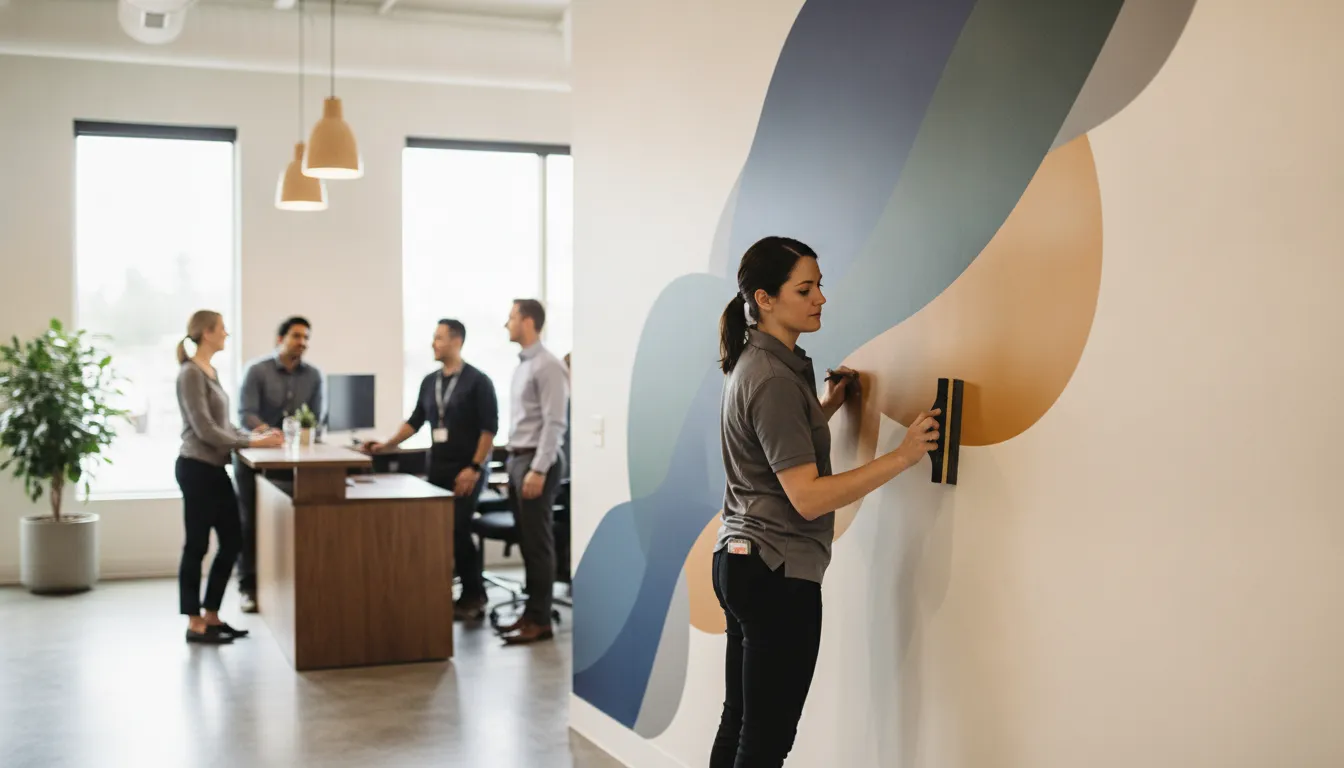
Textured wall decals for business spaces turn brick, concrete, masonry, and other distinctive surfaces into branded visual assets. The best result comes from matching the material and adhesive to the wall, preparing artwork around architectural details, and coordinating a professional installation. APM PrintWorks helps Portland-area businesses review the site, produce large-format graphics, and schedule installation with the project goals and surface conditions in view.
Contact APM PrintWorks to plan your wall installation
What Are Textured Wall Decals for Business?
Textured wall decals are custom-printed large-format graphics selected for walls that have more character than smooth, painted drywall. The texture may come from exposed brick, concrete, masonry, plaster, or another finished surface. Rather than treating every wall as interchangeable, a commercial decal project considers the surface, adhesive, image, environment, installation duration, and future removal plan together.
A decal that performs well on smooth drywall may not conform or bond in the same way on a rough wall. Raised faces, mortar joints, pores, coatings, dust, and moisture can reduce the contact area between the adhesive and the substrate. The wall also needs to be sound. Flaking paint, loose drywall paper, recent patching, grease, and dampness can affect both installation and removal.
These graphics can support a broad range of business objectives. A workplace may use a reception wall to establish a stronger arrival experience. A hotel or restaurant may add atmosphere to a guest-facing area. A retailer may create a feature zone, reinforce a campaign, or guide visitors through a space. A warehouse or facility may use visual communication to improve navigation and reinforce safety practices.
The creative direction should follow the business goal and viewing distance. A wall seen from the entrance can carry a large, simple visual statement. A graphic viewed at close range can use more detail, but it still needs clear hierarchy and enough contrast against the wall texture. APM PrintWorks can review the intended application and recommend a practical production and installation approach for the Portland metropolitan area.
How to Plan Textured Wall Decals for Business
A successful project begins with a site-focused brief. Before artwork is finalized, gather the information that affects material selection, scale, access, and installation timing. This preparation reduces late changes and helps the printer and installer understand the conditions behind the design.
- Define the communication goal. Decide whether the wall should strengthen brand recognition, create an accent feature, support wayfinding, share a message, or establish a particular atmosphere. Identify the primary viewer and the distance from which the graphic will usually be seen.
- Document the wall. Photograph the entire wall and take close images of texture, seams, damaged areas, trim, corners, outlets, switches, vents, windows, doors, and nearby fixtures. Note whether the wall is interior or exterior and whether it is exposed to moisture, sunlight, cleaning, or heavy contact.
- Measure several points. Measure width near the floor, at the center, and near the ceiling. Measure height on the left, center, and right. Record recesses, columns, baseboards, ceiling changes, and areas that must remain uncovered. Multiple measurements reveal walls that are not perfectly square.
- Set coverage and margins. Decide whether the graphic runs into a corner, stops before trim, or leaves breathing room around architectural elements. Keep critical faces, logos, and focal details away from probable seams, edges, outlets, and door swings.
- Prepare artwork for review. Provide the highest-quality approved artwork available, the intended final dimensions, wall photographs, measurements, and a list of exclusions. Identify the person authorized to approve color, scale, cropping, and final placement.
- Confirm access and scheduling. Coordinate furniture moves, building access, work hours, occupant routing, site contacts, and any required protection for adjacent finishes. Installation timing depends on surface review, artwork approval, production, and installation scheduling.
This process is useful whether the project covers one feature wall or a connected series of graphics. It also helps determine whether the wall should carry the full image, a simplified pattern, or a combination of graphics and physical signage. For projects that need additional directional elements, review APM PrintWorks sign solutions as part of the broader visual plan.
Which Surfaces Work Best for Textured Wall Decals?
Surface compatibility is the foundation of a dependable installation. Smooth, clean, fully cured painted drywall is usually the most consistent starting point. It still requires inspection for dust, grease, moisture, loose paint, recent paint, patching compound, and uneven areas. A clean appearance alone does not confirm that a wall is ready for adhesive graphics.
Brick and masonry
Textured brick creates visual depth but also reduces continuous adhesive contact. Mortar joints, pores, raised faces, and irregular edges can make it harder for a graphic to conform. Some brick is sealed or painted, while other brick is highly porous. The difference matters. A small test application can help determine whether the material follows the surface and whether the edges remain secure.
Concrete and plaster
Concrete may be smooth, rough, porous, sealed, coated, damp, or recently finished. Plaster and textured paint can introduce similar variation. A site review should identify loose material, cracks, dust, moisture, and coating compatibility before production. If the wall does not provide a dependable foundation, surface preparation or an alternate display method may be more practical than forcing a decal application.
Glass and other smooth surfaces
Glass is smooth, but it is not automatically simple. Cleaning quality, condensation, sunlight, edges, hardware, and privacy requirements all affect the plan. Consider how the graphic will be viewed from each side and how it will be cleaned. Other substrates, including outdoor fences or asphalt, add weather, temperature changes, wind, and surface movement to the assessment. No substrate should be treated as universally suitable without reviewing the actual site.
Request a material sample or adhesion test when the wall is strongly textured, porous, coated with an unknown finish, recently painted, exposed to moisture, or especially valuable. A test can reveal whether the decal conforms, whether edges lift, and whether removal changes paint or leaves residue. APM PrintWorks can use the project details and site conditions to help a Portland-area team choose a realistic path.
How Should Artwork and Measurements Be Prepared?
Artwork needs to be designed for the wall, not simply resized until it fills the measured area. Start with a clear visual hierarchy. Establish the primary brand or message, then determine which supporting shapes, images, or patterns can remain visible when the wall texture interrupts the image. A busy design may lose clarity on a rough surface, while a bold composition with generous contrast can remain effective.
Use wall photographs to identify visual obstacles before design approval. A door, outlet, vent, column, corner, or ceiling change may divide the image in an awkward place. Place important faces and focal elements away from seams and hardware. If the graphic must wrap around a corner, confirm how the image should transition and where a viewer will normally stand.
Measure the wall at multiple points and send the measurements with photographs. Note whether dimensions include baseboards, trim, or clear space. If the wall is not square, the production team may need to account for the variation in the panel layout or create a controlled margin. Do not assume that a single width and height captures the full installation area.
Artwork review should cover scale, resolution, color expectations, cropping, panel divisions, edge treatment, and the final coverage area. Confirm the approval process before production. A named decision-maker and a documented final proof reduce the risk of producing a graphic that is visually strong but does not fit the intended site.
Large wall projects may require panels or a planned seam strategy. Discuss seam locations early, especially when the wall has architectural breaks. APM PrintWorks supports large-format production for substantial wall applications, with the final production method based on the artwork, wall dimensions, access, and installation conditions. If the visual program extends beyond walls, business banners can provide a coordinated message in other locations.
How Durable Are Commercial Textured Wall Decals?
Durability depends on the relationship between the face material, adhesive, wall, environment, and maintenance routine. There is no single lifespan that applies to every textured surface. Before production, define whether the graphic supports a short campaign, a planned interior update, or a longer-term branded environment. That change cycle should influence material and installation decisions.
A clean, sound wall provides a better foundation than a dusty or deteriorating one. Heavy texture, moisture, grease, loose paint, and uneven coatings can reduce adhesive contact. High-contact corridors, entrances, service areas, and locations near furniture place more stress on edges and corners than protected feature walls. Identify those conditions during planning rather than treating a commercial decal as indestructible.
Cleaning also affects performance. Document the products, tools, and frequency used in the space. Confirm that the proposed material is appropriate for that routine, and give occupants practical care instructions after installation. Avoid aggressive scrubbing, sharp tools, and unapproved chemicals near graphic edges. If furniture or equipment will regularly rub the wall, adjust the placement or protection plan.
For a temporary campaign, a material and adhesive approach that supports planned change may be more important than maximum permanence. For a longer-term installation, secure bonding and resistance to the actual environment may take priority. A small test is especially valuable when the business expects frequent updates or when the wall finish is unfamiliar.
APM PrintWorks evaluates the application in context instead of promising an unsupported lifespan. This review helps Portland-area businesses align durability expectations with traffic, cleaning, moisture, sunlight, surface texture, and the planned replacement cycle. For related floor applications, see floor graphics and compare how placement changes wear and maintenance requirements.
What Should Businesses Know About Installation and Removal?
Installation planning should begin before the graphic reaches the wall. Clear furniture and movable equipment, identify sensitive finishes, and confirm access hours with building operations. Schedule the work during a lower-traffic period when possible. Decide how employees, customers, and visitors will move around the work area, and document the wall condition before installation begins.
Professional installation can improve alignment, edge finishing, panel consistency, and the handling of corners and architectural interruptions. It also gives the marketing and facilities teams one coordinated point of contact. APM PrintWorks manages projects from consultation and surface assessment through large-format production and installation, helping reduce disruption for Portland-area businesses.
Removal should be planned at the beginning, not added after the graphic has been approved. Discuss how long the decal should remain, what the underlying wall is made of, and whether the business expects to refresh the artwork. Low-tack approaches may support easier removal in suitable conditions, but low tack does not guarantee damage-free results. Paint age, drywall paper, moisture, dust, previous coatings, installation age, and removal technique all influence the outcome.
When it is time to remove a graphic, follow the installer guidance and work carefully. Avoid aggressive pulling when the substrate begins to lift. Inspect the wall after removal and allow time for surface repair or cleaning if needed. If the business plans a replacement, schedule the inspection and next artwork review early enough to avoid an empty or unfinished wall.
Where Can Textured Wall Decals Add Business Value?
The strongest application connects the wall to a real business purpose. In a workplace, a graphic can strengthen the reception experience, define a collaborative area, support internal wayfinding, or add character to a meeting space. In hospitality, it can establish atmosphere in a lobby, dining area, entry, or feature wall. In retail, it can highlight a department, reinforce a seasonal direction, or make a destination area easier to notice.
Consider the relationship between the wall and the rest of the environment. A decal may work alongside dimensional letters, directional signs, window graphics, or floor treatments. If vehicles also carry the visual identity, vehicle wraps and graphics can extend the same brand system beyond the building.
| Setting | Potential goal | Planning priority |
|---|---|---|
| Workplace | Improve arrival, reinforce culture, or guide employees and visitors. | Coordinate with doors, fixtures, furniture, viewing distance, and daily traffic. |
| Hospitality | Create a distinctive atmosphere in guest-facing spaces. | Consider cleaning, guest contact, lighting, seasonal updates, and access hours. |
| Retail | Highlight a department, campaign, or feature area. | Use clear hierarchy and account for customer flow, displays, and changing promotions. |
| Facility | Support navigation, identification, or safety communication. | Prioritize legibility, durability, visibility, and coordination with signs. |
APM PrintWorks is a local Portland-area provider for businesses and organizations that need large-format visual communication. A custom quote should reflect the wall condition, artwork, dimensions, material, production needs, installation scope, and access requirements. Turnaround depends on surface review, artwork approval, production, and installation scheduling, so confirm those milestones before setting an internal launch date.
Request a custom quote for your textured wall decal project
Frequently Asked Questions
Can textured wall decals be installed on brick or concrete?
They may be suitable for some brick and concrete surfaces, but the actual wall must be reviewed first. Texture, porosity, coatings, dust, moisture, and mortar joints affect adhesive contact. A sample or test application can help confirm whether the selected material conforms and whether the edges remain secure.
How should a business prepare for a wall decal installation?
Provide wall photographs, multiple measurements, artwork, the intended coverage, and notes about doors, outlets, fixtures, corners, and areas to avoid. Confirm the installation access window, furniture moves, site contact, occupant routing, and the person who will approve the final proof.
Will removing a textured wall decal damage the wall?
Removal results depend on the wall condition, paint, coating, adhesive, installation age, texture, and technique. No removal method is universal. Discuss the future change cycle before production, test a small area when appropriate, and have the installer remove the graphic carefully rather than pulling aggressively.
How long does a textured wall decal project take?
Timing depends on surface review, artwork approval, production, and installation scheduling. A project may also require site preparation, access coordination, furniture moves, or a material test. APM PrintWorks can provide a project-specific schedule after those requirements are understood.
Talk with APM PrintWorks about your Portland-area wall graphic