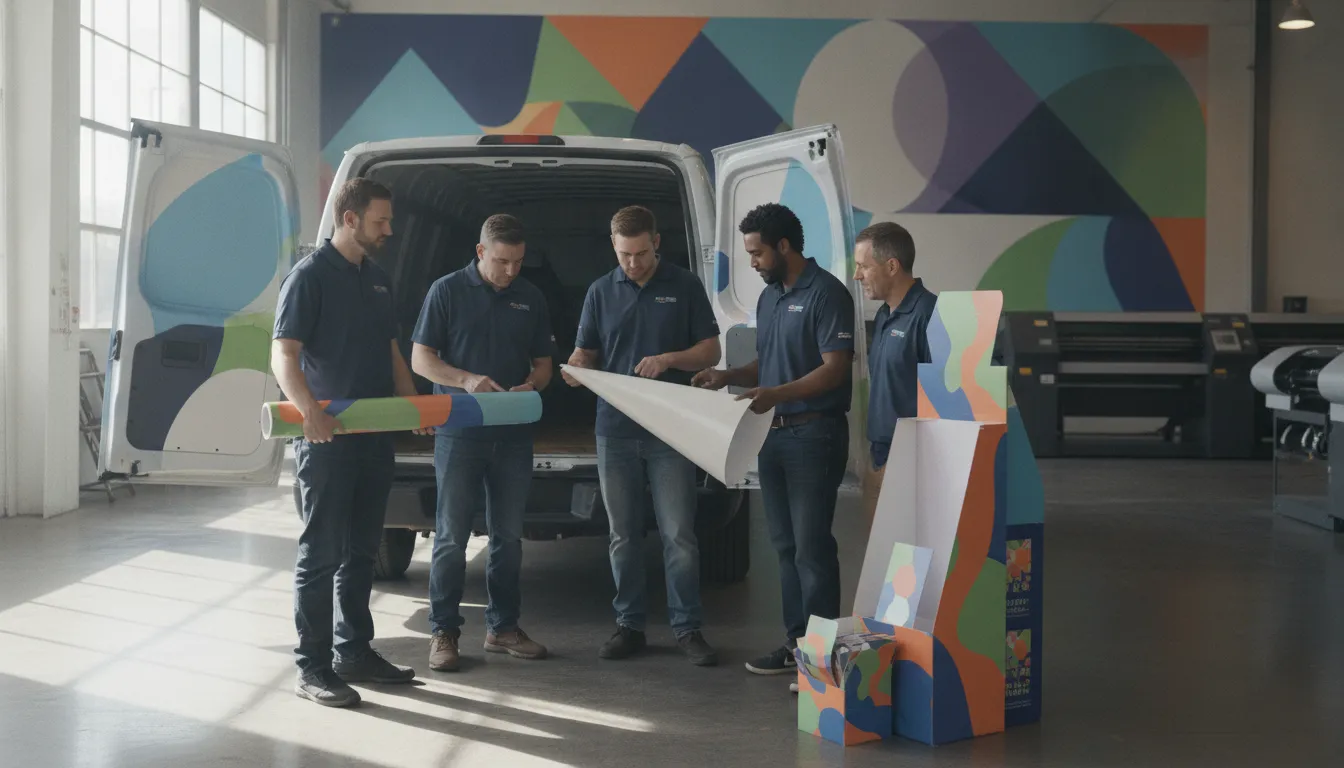
When a beverage campaign appears on delivery vehicles, retail displays, walls, and signs, customers should recognize the same brand immediately. They should recognize it at one location or across an entire market. That takes more than placing a logo on multiple surfaces. It requires a shared visual system, accurate site information, material choices suited to each environment, and a rollout process that keeps every location aligned.
Effective liquor distributor branded graphics connect approved brand elements with the realities of fleets, stores, and facilities. Start with a coordinated plan that defines logo hierarchy, colors, messaging, dimensions, materials, proofing, and installation standards before production begins.
APM PrintWorks helps Portland-area businesses move from consultation and specifications to mockups, production, and installation through a practical Dream, Plan, Create approach.
Request a project consultation
Consistency becomes easier to protect when the team treats every touchpoint as part of one governed brand system. The first step is defining the standards and checkpoints that make that system repeatable across locations.
What Makes Liquor Distributor Branded Graphics Consistent Across Locations?
Consistency starts with a master brand system, not with printing the same file repeatedly. Define the elements that must remain fixed across every location, including approved logos, color values, type styles, image treatment, messaging hierarchy, and minimum clear space. Then identify what can change by market, account, campaign, or placement. This gives sales and operations teams a practical standard to follow without forcing every site into an identical layout.
Co-branding needs its own rules. Supplier-approved brand logos and local distributor or account branding may both belong in the design, but their relationship should be decided before artwork is produced. Establish which logo leads, where the partner mark appears, how large each can be, and who approves the final combination. Industry examples show supplier-approved logos paired with local distributor or account branding in market-facing assets. Make logo hierarchy part of the system, not a last-minute adjustment. APM beverage display graphics can support the large-format and display side of this planning process.
Build location flexibility into the standard
A shared template still needs location-specific inputs. Capture the dimensions, viewing distance, mounting surface, access conditions, lighting, traffic patterns, and indoor or outdoor exposure for each site. A window, delivery vehicle, retail wall, and exterior sign may use the same visual language while requiring different proportions, materials, and installation details. Treat each location as a controlled variation of the master system, not as an opportunity for an improvised redesign.
Proofing is the quality-control checkpoint between the standard and the physical site. Review a scaled mockup for composition, logo order, copy, color intent, safe areas, and how the graphic will be seen in context. For repeat locations, retain the approved proof and the measurement record together. That makes revisions easier to trace and helps prevent an old logo, incorrect account name, or mismatched dimension from entering production.
Govern the rollout after approval
Assign ownership for brand approvals, account approvals, site measurements, production release, installation, and final photo documentation. Keep a version-controlled artwork library with a clear status for approved, superseded, and location-specific files. A rollout tracker can record each location, assigned artwork, material, quantity, delivery or installation status, and exceptions. For a deeper implementation framework, see this multi-location signage rollout guide.
APM’s Dream, Plan, Create framework reflects this sequence: begin with the vision, plan through specifications, budget assessment, and mockups or proofs, then move into experienced production. That structured handoff helps distributor teams protect brand standards while adapting graphics to real sites and changing campaign requirements.
How to Match Graphics to Each Distribution and Retail Touchpoint
A coordinated program works best when each graphic is chosen for the way people encounter it. A delivery vehicle is mobile and viewed at changing distances. A retail window must attract attention without blocking visibility. A wall graphic reinforces the environment, while a sign has to communicate quickly from a specific approach. Treating every surface as the same print job usually creates unnecessary production problems and inconsistent brand experiences.
Vehicles: build a fleet system, not a collection of one-offs
Start with the vehicle types, body panels, viewing angles, and routes involved. A full wrap can create a high-impact moving canvas. Partial wraps, spot graphics, custom-cut vinyl decals, or magnets may be more practical for certain vehicles, temporary programs, or changing account assignments. Keep the core brand elements in consistent positions across the fleet. Reserve flexible areas for product lines, market-specific messaging, or account information. APM supports full, temporary, permanent, partial, and spot wraps, along with fleet graphics programs. See the options for vehicle wraps and fleet graphics when defining the fleet standard.
Vehicle graphics also need an upkeep plan. Consider washing methods, high-contact areas, replacement timing, and how a damaged panel will be reproduced without creating a visible mismatch. A documented fleet graphics maintenance guide can help operations teams keep the program consistent after installation.
Retail displays and windows: design for the shopper’s path
Retail materials should support the moment when a shopper notices, considers, and selects a product. Beverage-industry display examples include case cards, standees, display racks, shelf-talkers, and customized window signage. Use larger, simpler graphics where shoppers pass quickly, and reserve more detailed information for locations where they can pause. Window graphics should account for sightlines, interior lighting, reflections, and whether the glass must remain partially visible. Review the planning considerations for retail window graphics before finalizing dimensions and placement.
Walls and signs: match permanence and distance
Wall graphics are useful for creating a branded back wall, warehouse feature, tasting-area environment, or recurring account presentation. Choose vinyl, wallpaper, or another wall treatment based on the surface, expected lifespan, cleaning conditions, and whether the message will change. For long expanses, APM can produce seamless graphics up to 150 feet. The guide to commercial wall graphics can help teams compare material approaches.
Signs need a clear job: identify an entrance, direct movement, call attention to a display, or establish a branded presence outdoors. Specify viewing distance, mounting method, wind exposure, portability, and indoor or outdoor conditions before choosing a substrate or format. A-frame signs, banners, yard signs, and other large-format displays may serve different points in the same account. Use the planning guidance for business wayfinding signs to keep the message legible and the installation practical. Professional installation can support vehicle wraps, walls, windows, and other large-format graphics when the surface or scale requires it.
How Do You Plan a Multi-Location Graphics Rollout?
A coordinated rollout works best when every location follows the same visual system. While each site still receives graphics suited to its vehicles, walls, windows, signs, and operating conditions. Treat the project as a repeatable process rather than a series of disconnected print orders. The following sequence helps distributor brand managers, sales teams, and operations leaders reduce surprises and keep local execution aligned.
- Inventory every location and graphic need. Build a master list of sites, vehicles, retail accounts, warehouses, and other placement areas. Record what each location needs, such as fleet graphics, window graphics, wall branding, banners, or wayfinding signs. Include quantities, campaign timing, destination contacts, access restrictions, and whether the item is temporary, permanent, portable, indoor, or outdoor. This inventory becomes the working brief for the entire program and exposes gaps before artwork is prepared.
- Set the brand and approval standards. Gather current logos, color specifications, type treatments, photography rules, required account or supplier branding, and examples of approved applications. Decide which elements must remain consistent everywhere and which may change by market or account. Assign one owner for brand approval and one operational contact for site execution. A written standard prevents local teams from making incompatible edits after production has begun.
- Capture site measurements and conditions. Confirm the usable dimensions, mounting surfaces, viewing distance, vehicle type, window obstructions, lighting, weather exposure, and installation access at each site. Do not rely on a generic dimension from one location for every other location. Note lift, ladder, parking, delivery, and removal requirements where relevant. These details guide material and finishing decisions and help distinguish a reusable master design from location-specific production files.
- Prepare proofs before releasing production. Create a location-by-location proof set that shows scale, placement, copy, logos, colors, and quantities. Route proofs through the designated brand, supplier, account, and compliance reviewers before approval. Keep a dated record of the final version so production and field teams are working from the same file. APM’s documented planning process includes detailed specifications, budget assessment, and mockups or proofs as part of its vision-to-production workflow, but the distributor remains responsible for its internal approvals. This multi-location signage rollout guide can provide an additional governance framework.
- Coordinate production and fulfillment. Release approved files with a packing list that identifies each location, item, quantity, finish, and installation or delivery instruction. Group shipments by site rather than by graphic type when that reduces field sorting. Set a communication plan for substitutions, damaged pieces, schedule changes, and partial releases. APM states that it can support campaigns ranging from a single piece to programs involving more than 100 projects, with installation coordination available locally, regionally, and nationwide. Confirm the actual scope, materials, and logistics for your program during planning.
- Complete installation and photo QA. Before closing a location, verify that the correct graphic is installed in the approved position. Edges and surfaces are clean, colors and logos match the proof, and surrounding fixtures have not obscured the message. Collect dated installation photos, note exceptions, and obtain site sign-off. Review the photo set centrally so recurring issues can be corrected before the next wave. This final record also creates a useful baseline for maintenance, replacement planning, and future campaign updates.
Using the same sequence for every wave gives a multi-location program structure without forcing every site into identical materials or dimensions. It also gives the distributor a clear handoff between brand strategy, field operations, production, and installation.
Where Does Compliance Review Fit in Branded Graphics Planning?
Compliance review belongs after the creative direction is defined and before artwork is released for production. That checkpoint gives the distributor, supplier, retailer, and any designated legal or compliance reviewer a clear version to evaluate. It also prevents a finished fleet graphic, retail display, wall graphic. Or sign from reaching production before the responsible team has confirmed that its claims, brand elements, retailer references, and required information are appropriate for the market.
The review should begin with an inventory of every public-facing element in the campaign. The TTB’s advertising guidance describes advertising broadly, including written or verbal statements, illustrations, and depictions intended to induce sales. Its examples extend beyond traditional ads to product displays, indoor signs, outdoor signs, billboards, transit cards, websites, social networks, mobile apps, links, and QR codes. For a graphics program, that means the review should account for the complete customer journey, not just the primary printed piece.
Build review into the proofing checkpoint
Once the production team has prepared a proof, route it to the distributor’s designated reviewer with the intended placement and market listed. Ask the reviewer to confirm the approved brand artwork, product names, claims, retailer or account references, contact information, and any required disclosures. For wine advertising, TTB guidance generally identifies the responsible advertiser’s name and contact information, along with the product class, type, or distinctive designation corresponding to the approved label. Those details can be easy to overlook when a design is adapted across window signage, case cards, vehicle graphics, or a multi-location rollout.
This is also the right moment to separate creative approval from compliance approval. A production partner can organize files, apply dimensions, prepare proofs, and coordinate printing or installation. The distributor or its appointed legal and compliance team must decide whether the content is permitted. APM PrintWorks should not be presented as providing legal review, interpreting regulations, or guaranteeing that a campaign satisfies every jurisdiction.
Expect rules to vary by market
Requirements can change based on the state, the product, the placement, and the relationship between the distributor and the retailer. For example, Texas TABC guidance on alcohol marketing practices discusses the independence of manufacturers, distributors or wholesalers, and retailers within a three-tier system. It also addresses services, benefits, retailer-identifying advertising, and who pays for an advertisement. That is a useful reminder that a co-branded sign or retailer-specific display may deserve a different review than a general brand asset. It is not a nationwide rulebook.
For liquor distributor branded graphics, document the approval owner, approved version, markets covered, expiration or replacement date, and installation locations. Keep the final proof and approval record together with the production specifications. This simple handoff creates a reliable pause between design and production while leaving legal interpretation with the people qualified and authorized to provide it.
How Should Distributors Budget and Schedule a Graphics Program?
A practical budget starts with the rollout you actually need, not with a generic price list. A single replacement graphic, a limited pilot, and a coordinated program across many accounts each create different requirements for design, materials, proofing, fulfillment, and installation. Define the scope first, then ask for a quote that reflects the real production plan.
For APM PrintWorks, pricing is primarily custom-quote based. Project complexity, volume, materials, and production processes all affect the final cost. That approach gives a distributor room to compare a focused first step with a broader rollout without forcing every location into the same package. The planning process can include a vision consultation, detailed specifications, budget assessment, and mockups or proofs before production. See the APM beverage display graphics service overview for additional context.
| Program type | Scope | Materials | Proofing | Fulfillment | Installation |
|---|---|---|---|---|---|
| One-off | One vehicle, account, display, or replacement item | Choose for the specific surface, setting, and expected use | Confirm dimensions, artwork, color, and placement before production | Coordinate one delivery or pickup with the responsible team | Schedule around the site, vehicle, or account’s available access |
| Pilot | Test a repeatable concept at a small group of locations | Compare durability, appearance, and installation needs in real conditions | Review the master design plus location-specific adaptations | Document packing, labeling, delivery, and feedback for the next phase | Use early installations to identify access or surface issues |
| Multi-location program | Coordinated graphics across fleets, retail accounts, or territories | Standardize approved materials while allowing for site conditions | Approve brand standards, templates, measurements, and location proofs | Plan batches, labels, destinations, contacts, and installation sequence | Coordinate local or broader installation coverage and photo QA |
Scheduling should follow the decision points in the table. Reserve time for inventory, site measurements, artwork updates, approvals, production, shipping or delivery, and installation access. A pilot can reveal issues before a larger commitment, while a multi-location program benefits from shared specifications and a documented handoff process. Avoid setting a fixed promise until the quantities, surfaces, materials, proofing requirements, and locations are known.
For distributors in Portland, APM PrintWorks brings local production and planning support from its Beaverton facility, serving the greater Portland metro area. When a program extends beyond the region, broader installation coordination can be considered as part of the project plan. The result is a budget and schedule built around the graphics system, not just the individual printed pieces.
How Can a Portland Distributor Start a Branded Graphics Project?
Start with a clear project handoff rather than a vague request for “some graphics.” A focused brief helps your print partner understand the brand. The locations, and the operational details that determine production and installation. It also gives your team a practical basis for reviewing proofs and approving the work.
Build the handoff around these details
- Goals: Explain what the graphics should accomplish, such as improving fleet visibility, supporting a retail promotion, reinforcing a supplier brand, or creating a consistent experience across accounts.
- Locations: List every warehouse, vehicle, retail account, or other site involved in the initial project. Include addresses, local contacts, access restrictions, and whether the work is a pilot or part of a broader rollout.
- Surfaces and conditions: Identify vehicle panels, windows, walls, floors, signs, or display areas. Note dimensions, surface condition, indoor or outdoor exposure, wind, portability, and any installation limitations. Material and format selection should reflect those conditions, not just the artwork.
- Artwork and brand standards: Provide logos, color references, approved imagery, required copy, file formats, and supplier or account branding guidance. If multiple brands or retailers are involved, identify who approves each version before production.
- Quantities: Separate the number of pieces by format, location, vehicle, or account. Distinguish initial production from replacement stock so fulfillment and future updates can be planned accurately.
- Timing and dependencies: Share campaign launch dates, delivery windows, vehicle availability, store access, and any internal approval deadlines. Avoid assuming that every location can be produced or installed in the same sequence.
- Installation: Decide whether your team will install the graphics or whether professional installation is needed. APM offers professional installation for vehicle wraps, wall graphics, window displays, and floor graphics, with project coordination available for larger geographic footprints.
- Decision-makers: Name the brand, sales, operations, creative, and compliance contacts who need visibility. One designated project owner can keep questions, proof approvals, and location changes from becoming disconnected threads.
APM PrintWorks is based in Beaverton and serves the greater Portland area. Its beverage-industry work includes large-format printing and professional installation, while the final recommendation depends on the project scope. Review APM beverage display graphics for relevant capabilities, then share the handoff with the team. APM pricing is custom-quote based and depends on complexity, volume, materials, and production processes.
Request a project consultation
Frequently Asked Questions
What are effective advertising ideas for a liquor store?
Coordinate graphics across the shopper journey instead of relying on one sign. Window graphics can create visibility from the street, while case cards, shelf-talkers, standees, display racks, and aisle signs can reinforce the product story near the point of purchase. A consistent color palette, logo hierarchy, and message system helps each piece feel like part of the same campaign.
What do liquor distributor branded graphics usually include?
A coordinated program can include fleet graphics, temporary or permanent retail displays, window graphics, wall graphics, interior and exterior signs, and location-specific decals. The right mix depends on the campaign goal, account environment, installation surface, and whether the graphics need to be refreshed or remain in place.
How do distributors keep graphics consistent across multiple locations?
Start with an approved master artwork package, then create a location inventory with measurements, surfaces, quantities, and installation notes. Require proofs before production, document any account-specific adaptations, and use a shared fulfillment and photo-review process after installation. This keeps local execution flexible without losing the supplier or distributor brand standard.
Which materials work best for distributor graphics?
Material selection should follow the surface, exposure, lifespan, and removal needs. Interior walls, storefront windows, fleet vehicles, and exterior signs each have different performance requirements. A print and installation partner can recommend the appropriate substrate, adhesive, finish, and mounting method after reviewing site conditions rather than choosing one material for every application.
Where does compliance review fit into the process?
Include the distributor’s legal or compliance reviewer before final artwork approval, especially when graphics promote an alcoholic beverage. The TTB treats written statements, illustrations, and other promotional materials, including shelf-talkers, as potential advertising, so requirements can apply beyond traditional ads: TTB advertising guidance. Rules can also vary by jurisdiction, so compliance review should happen before production and rollout.
Get started with a coordinated graphics plan
A clear plan can help your team align vehicle graphics, retail displays, wall graphics, signs, and location-by-location rollout details before production begins. APM PrintWorks can help you organize the scope, review specifications, and identify the right next steps for your distributor program.