
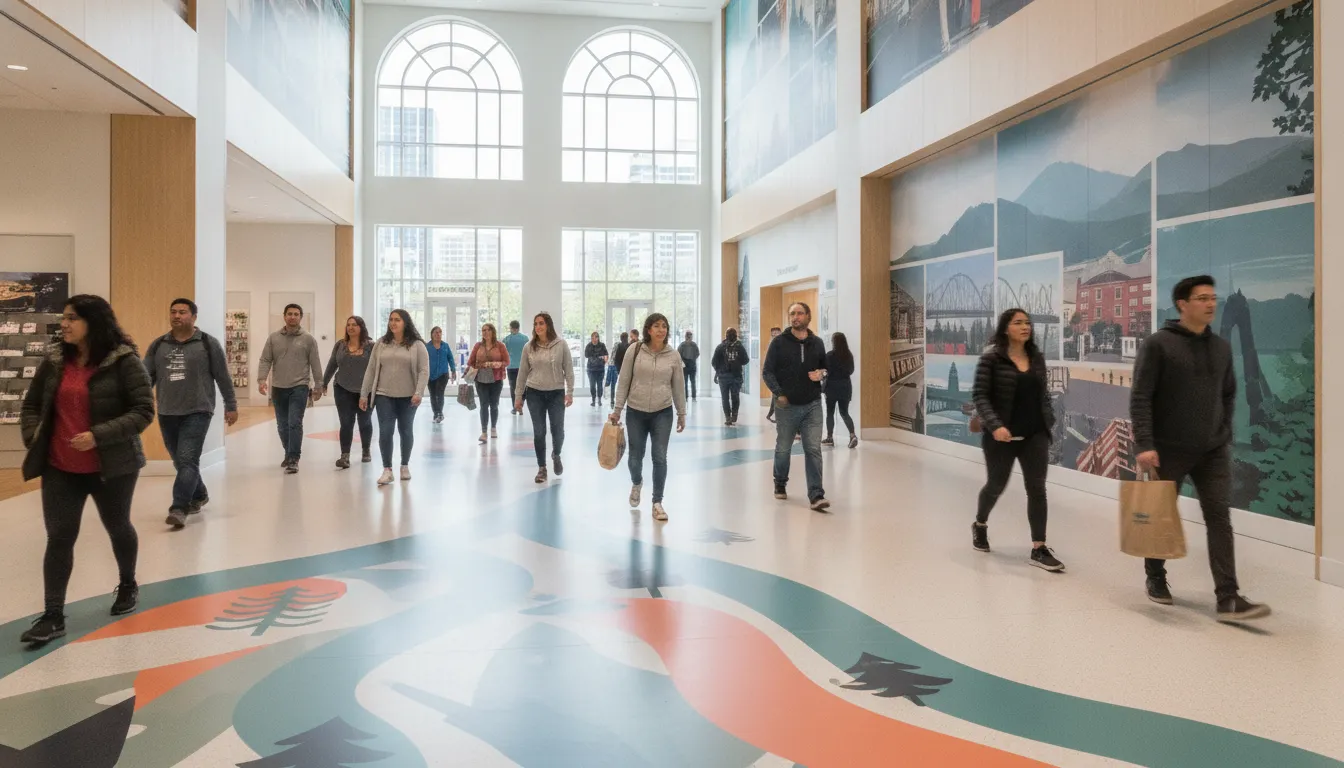
A floor graphic has to do more than attract attention. It needs to suit the surface, traffic pattern, cleaning routine, and schedule of the space around it. A graphic planned for a covered retail entrance may need a different material and installation approach than one used outdoors at a venue or across a busy facility corridor.
Plan your commercial floor graphics with APM PrintWorks
Commercial floor graphics are custom printed graphics designed for branding, promotion, wayfinding, or safety communication on commercial walking surfaces. The right solution depends on the environment, expected traffic, surface condition, slip-resistance needs, maintenance plan, and how the graphic will be removed later.
For Portland-area retailers, facilities, and venues, thoughtful planning helps the finished installation look intentional while supporting safe, practical movement through the space. APM PrintWorks works with local organizations from its Beaverton production facility, coordinating creative, production, and installation around the project requirements. Start with what these graphics are, where they work best, and what they need to perform well.
What Are Commercial Floor Graphics?
Commercial floor graphics are printed graphics applied directly to a floor or other walking surface. They can communicate, promote, brand, or guide. Many use adhesive-backed vinyl printed in full color. The right product depends on the installation area, expected traffic, and planned duration. A graphic inside a retail store has different needs than one exposed to weather at an entrance or sidewalk.
In a commercial space, the floor can become an active part of the customer experience. A branded shape or pattern can reinforce a campaign or extend visual identity beyond walls and windows. Directional graphics can help visitors find a counter, queue, department, elevator, or event area. Promotional graphics can draw attention to a featured product or seasonal message without taking up valuable wall space. Facilities and workplace teams may also use floor graphics to support navigation and communicate safety information.
The most effective design starts with the movement of people through the space. Consider what visitors should notice, where they naturally look, and whether the message needs to be understood at a glance. Placement, contrast, shape, copy, and scale should work together without creating confusion or obstructing the way people move. The surface, cleaning routine, expected traffic, and removal plan also belong in the conversation before production.
This broad guide covers the decisions that shape a floor-graphics project, including indoor and outdoor material planning, surface preparation, placement, slip resistance, wear, maintenance, and removal. It is not limited to one application. For a closer look at store navigation and promotions, see APM’s retail floor graphics resource. Safety-focused projects may require a different review, while durability deserves its own condition-specific assessment.
APM PrintWorks brings creative, production, and professional installation together for Portland-area businesses and organizations. From its Beaverton production facility, APM serves retailers, hospitality businesses, venues, facilities teams, and safety-conscious organizations with a practical planning process. The team can help evaluate the environment, discuss materials and installation requirements, and develop a proof before production, so your commercial floor graphics support the space rather than simply decorate it.
How Do You Choose Indoor or Outdoor Floor Graphic Materials?
The right material begins with the setting, not the artwork. A graphic inside a climate-controlled lobby has different demands from one near an uncovered entrance or on an exterior pedestrian route. Start by identifying the surface, expected traffic, exposure, campaign length, and cleaning routine. Then match the adhesive, protective finish, and installation approach to those conditions.
Indoor and outdoor floor graphic planning considerations| Planning factor | Indoor environment | Outdoor or exposed environment |
|---|---|---|
| Environment | Consider the flooring material, texture, cleaning process, and whether the area is carpeted or hard surfaced. | Account for the substrate, drainage, weather, and transitions between exterior and interior surfaces. |
| Traffic and wear | Entrances, queues, aisles, and public corridors may need a finish selected for frequent footsteps, carts, or routine maintenance. | Plan for footsteps and, depending on placement, bicycle tires and other outdoor traffic. The exposure level should guide product selection. |
| Rain and sunlight | Weather exposure may be limited, but tracked-in moisture and spills still affect placement and maintenance. | Rain, snow, moisture, and sunlight can change the demands on the graphic, adhesive, and protective surface. 3M describes its floor graphic films as designed for floor and sidewalk applications, including these exposure concerns. |
| Adhesive and finish | Choose an adhesive compatible with the floor and a finish that supports the intended appearance, cleaning, and use. | Confirm that the adhesive and finish are appropriate for the exterior substrate and anticipated weather. Do not assume an indoor product transfers outdoors. |
| Project duration | Short promotional graphics and longer-term branding call for different material and removal plans. | Set expectations around the specific exposure and maintenance plan rather than relying on a generic duration. |
Product selection also needs to account for how the floor will be cleaned and how the graphic will be removed. A finish that looks right in a proof may not be the best fit for a busy entryway, a facility with scheduled scrubbing, or a temporary promotion. Surface preparation matters just as much as the printed film because dust, moisture, residue, and incompatible coatings can affect adhesion.
For Portland-area retailers, venues, facilities, and organizations, APM PrintWorks can review the application before production. Its team confirms the surface, traffic, weather exposure, adhesive, finish, slip-resistance requirements, cleaning routine, and removal plan, then recommends a practical path. Review APM’s commercial floor graphics service to see how material planning and installation fit into the larger project.
When the environment is unusual or the installation carries safety implications, request a product-specific recommendation and proof before approving production. That extra planning helps the graphic perform as intended without forcing one material into every application.
What Surface Preparation Helps Floor Graphics Last?
Even well-chosen commercial floor graphics can fail early when the surface is dusty, damp, damaged, or still affected by cleaning chemicals. Preparation is not a cosmetic step. It gives the adhesive a cleaner, more stable surface and helps the installer identify conditions that could create lifting edges, bubbles, or premature wear. It also supports safer use after installation.
Before scheduling production or installation, work through the following preparation sequence:
- Inspect the entire installation area. Identify the floor material, seams, grout lines, cracks, loose coatings, texture changes, drains, transitions, and areas exposed to unusual traffic. Note doors, carts, pallet equipment, entrances, and other points where graphics may experience extra abrasion. The actual surface and environment should guide material and adhesive selection.
- Confirm the walking surface is clean and hazard-free. Remove dirt, grease, residue, loose particles, spills, and other contaminants. OSHA’s walking-working-surface standard calls for surfaces to be clean, orderly, sanitary, and as dry as feasible. It also identifies spills, leaks, snow, ice, and loose or protruding objects as hazards that require attention. Review the standard at OSHA 1910.22. Then apply the same practical discipline to the planned graphic area.
- Use the right cleaning process for the floor. Follow the flooring manufacturer’s maintenance instructions and remove cleaner, wax, oil, and other film that could interfere with adhesion. Do not assume a floor that looks clean is ready for graphics. A final wipe or preparation method may be appropriate, but the installer should confirm what is safe for that particular surface and finish.
- Allow the area to dry completely. Moisture trapped beneath a graphic can weaken adhesion and interfere with a smooth application. Account for damp weather at entrances, recent mopping, floor treatments, condensation, and cleaning schedules. Keep the area protected from new traffic, spills, and dust while it dries. Installation timing should be coordinated with the facility team, not just the print schedule.
- Repair or resolve surface defects first. Fill or stabilize cracks, loose material, damaged coating, uneven transitions, and other defects when appropriate. Graphics generally cannot correct an unstable or deteriorating floor. If a seam, textured area, or irregular transition must remain, discuss whether the design should avoid it or whether a different material or application method is needed.
- Test a small area and coordinate the installation. When the surface, finish, or cleaning history is uncertain, request a test area before producing the full run. Check adhesion, appearance, edge behavior, and removal expectations under representative conditions. APM’s commercial floor graphics team can help review the surface, traffic, material, finish, cleaning plan, and installation requirements. Portland-area facilities and retailers can also coordinate access windows, barricades, cleaning, and post-installation inspection with APM’s in-house production and installation teams.
Good preparation does not replace product-specific testing or ongoing maintenance. It gives the installation a sound starting point and helps the project team address risks before graphics reach the floor.
How Should Commercial Floor Graphics Address Slip Resistance?
Slip resistance should be treated as a product-and-environment question. It is not a blanket promise attached to every floor graphic. A graphic that performs appropriately in a clean, dry interior may not be the right choice for an entryway exposed to rain, tracked-in moisture, cleaning solutions, or winter conditions. Before production, identify where the graphic will go, how people will cross it, and what maintenance routine the site follows.
Ask the printer for the specific material’s documented testing, rating, and intended conditions of use. The rating must belong to the exact film, laminate, or finished system being proposed. For example, 3M identifies UL 410 approval for referenced floor-graphic products. That statement should not be transferred to an unspecified APM product or used as a substitute for product-level confirmation. Review the manufacturer’s documentation and confirm whether the proposed combination of graphic, adhesive, and surface finish has been evaluated for the application.
Testing language also deserves careful attention. A slip-resistance value is meaningful only when the measurement protocol is known. The U.S. Access Board explains that accessible surfaces should be stable, firm, and slip resistant, while noting that specific levels can only be meaningfully specified according to a particular measurement method. In practice, that means a salesperson’s general phrase such as “non-slip” is not enough for a high-consequence location. Review the Access Board’s guidance on accessible floor and ground surfaces when planning graphics near accessible routes.
Clean, dry conditions remain part of the safety plan even when the material has an appropriate rating. OSHA requires walking-working surfaces to be clean, orderly, sanitary, and as dry as feasible. Spills, leaks, snow, and ice can create hazards around or over a graphic, so assign responsibility for inspections, prompt cleanup, and replacement if edges lift or the surface becomes damaged. Do not assume a slip-resistant finish eliminates the risk created by moisture or poor maintenance.
For a workplace, warehouse, facility, or public-facing site, match the graphic to traffic, footwear, cleaning equipment, exposure, and removal needs. APM PrintWorks can review those conditions, recommend options, and coordinate production and installation from its Beaverton facility. Explore APM’s safety floor graphics guidance, then confirm the material, finish, testing documentation, cleaning plan, and installation details before approving the project.
Where Should You Place Floor Graphics in a Commercial Space?
The strongest placement starts with how people already move through the space. Walk the route from the entrance to the primary destination and note where visitors slow down, choose a direction, wait, or need reassurance. A graphic at an entry can welcome customers and establish the next step. In a lobby, a logo or directional cue can reinforce the brand without competing with reception signage. APM PrintWorks helps Portland-area businesses plan commercial floor graphics around the surface, traffic pattern, message, and installation conditions.
Use decision points, not empty floor
Place wayfinding graphics where a person must make a choice. Good locations include a corridor turn, an elevator bank, a service area, or the split between public and restricted spaces. Arrows and short messages work best when they are visible early enough to guide movement, but not so early that visitors forget the instruction. A coordinated floor graphic can support a broader system of business wayfinding signs. Floor-level cues and wall-mounted signs should point in the same direction.
Queues offer another useful opportunity. A series of footprints, numbered positions, or spacing markers can make a waiting area easier to understand. In retail settings, place promotional graphics along the path to a relevant display or at a point where shoppers naturally pause. See APM’s guide to retail floor graphics for ideas that connect navigation with customer engagement.
Review the route from every user’s perspective
Before approving a layout, view it from standing and approaching distances, including the sightlines of children, seated visitors, and people using mobility devices. Keep messages legible, avoid placing graphics where doors, fixtures, carts, or cleaning equipment will hide them, and leave clear routes rather than forcing people around a graphic. Facilities teams should also map cleaning paths and inspect areas where spills, tracked-in water, or heavy traffic are likely. Placement is not a substitute for an accessibility review or site-specific safety decision, so confirm the proposed material, finish, and location for the actual environment.
For a Portland or Beaverton venue, retailer, facility, or hospitality space, APM can review the floor plan. Discuss goals and traffic flow, and develop a practical placement plan before production.
Request a commercial floor graphics quote
How Long Do Floor Graphics Last and How Are They Removed?
There is no single service-life answer for commercial floor graphics. A graphic in a protected indoor corridor experiences a different workload than one near an entrance, checkout line, loading area, or outdoor walkway. Foot traffic, rolling equipment, bicycle tires, rain, snow, sunlight, cleaning methods, and the condition of the floor all influence how quickly edges, color, and surface texture show wear. The selected film, laminate, adhesive, and placement matter just as much.
Manufacturers describe broad capabilities rather than a guarantee for every installation. For example, 3M notes that some floor graphic films are designed to withstand thousands of footsteps and supports planning for both short-term promotions and longer-term branding. That does not make a fixed lifespan promise for your site. APM can help match the material and finish to the actual environment, expected traffic, cleaning routine, and campaign schedule. For more detail on the variables, review this guide to floor graphic durability.
Maintenance and inspection affect useful life
Routine observation is one of the simplest ways to protect a floor graphic and the people walking over it. Check for lifting corners, curled edges, bubbles, scratches, fading, trapped moisture, or changes in traction. Pay particular attention to entrances and other areas where grit, water, salt, or cleaning chemicals may collect. Follow the product-specific cleaning instructions, use appropriate equipment, and avoid treating every graphic as if it has the same finish or adhesive.
Regular inspections also help identify when a graphic has completed its useful role. Plan replacement or removal if the message is no longer legible, the edges become a trip concern, or the surrounding floor changes. Do not wait for a failure during a busy period.
Plan removal before production
Removal can be straightforward, but it is not identical for every project. Adhesive type, dwell time, temperature, floor coating, surface porosity, graphic construction, and cleaning history can all affect how a film releases. A short campaign may call for a different removable approach than a long-term installation. The installation team should confirm the intended removal method, test a representative area when appropriate, and coordinate work around operating hours.
APM PrintWorks plans these decisions with Portland-area businesses, facilities, retailers, and venues from its Beaverton production facility. Share the surface, location, traffic pattern, cleaning process, desired schedule, and removal expectations when requesting a custom quote. That local planning conversation helps ensure the graphic looks right at installation and remains practical to maintain and remove.
Frequently Asked Questions
What are commercial floor graphics?
Commercial floor graphics are custom printed graphics applied to suitable indoor or outdoor walking surfaces. Businesses use them for branding, promotions, wayfinding, queue guidance, facility communication, and safety messaging. The right product depends on the surface, environment, traffic, placement, and planned duration.
How long do floor graphics last?
There is no universal lifespan. Foot traffic, cleaning methods, sunlight, moisture, surface condition, material, finish, and installation all affect wear. Plan short-term promotions differently from longer-term branding, and have the material recommendation confirmed for your location and expected use.
What is the best material for a commercial floor graphic?
The best material is the one matched to the application, not a single product used everywhere. Indoor retail, outdoor walkways, entry areas, and high-traffic facilities can require different adhesives, finishes, and protective surfaces. Ask your printer to confirm slip resistance, cleaning compatibility, traffic tolerance, and removal requirements before production.
How much do floor decals cost?
Floor graphics are generally custom quoted. Size, quantity, artwork, material, surface, installation conditions, traffic, and removal requirements all affect the project. APM PrintWorks can discuss your goals and budget, recommend an approach, and develop a proof before production.
Can custom floor decals be removed after an event?
Yes, removable applications can be planned for temporary promotions, events, and changing facility messages, but removal depends on the adhesive, surface, installation period, temperature, and maintenance conditions. Confirm the removal method before approval so the installation plan protects the underlying floor.
Ready to Plan Your Commercial Floor Graphics?
Bring your facility, retail, venue, or organization’s floor graphic idea to APM PrintWorks. We can discuss the surface, environment, placement, material, and installation needs so the project fits your space and goals. APM serves Portland-area businesses and organizations from Beaverton with local creative, production, and installation support. Use the contact form to send us a message and discuss your project.