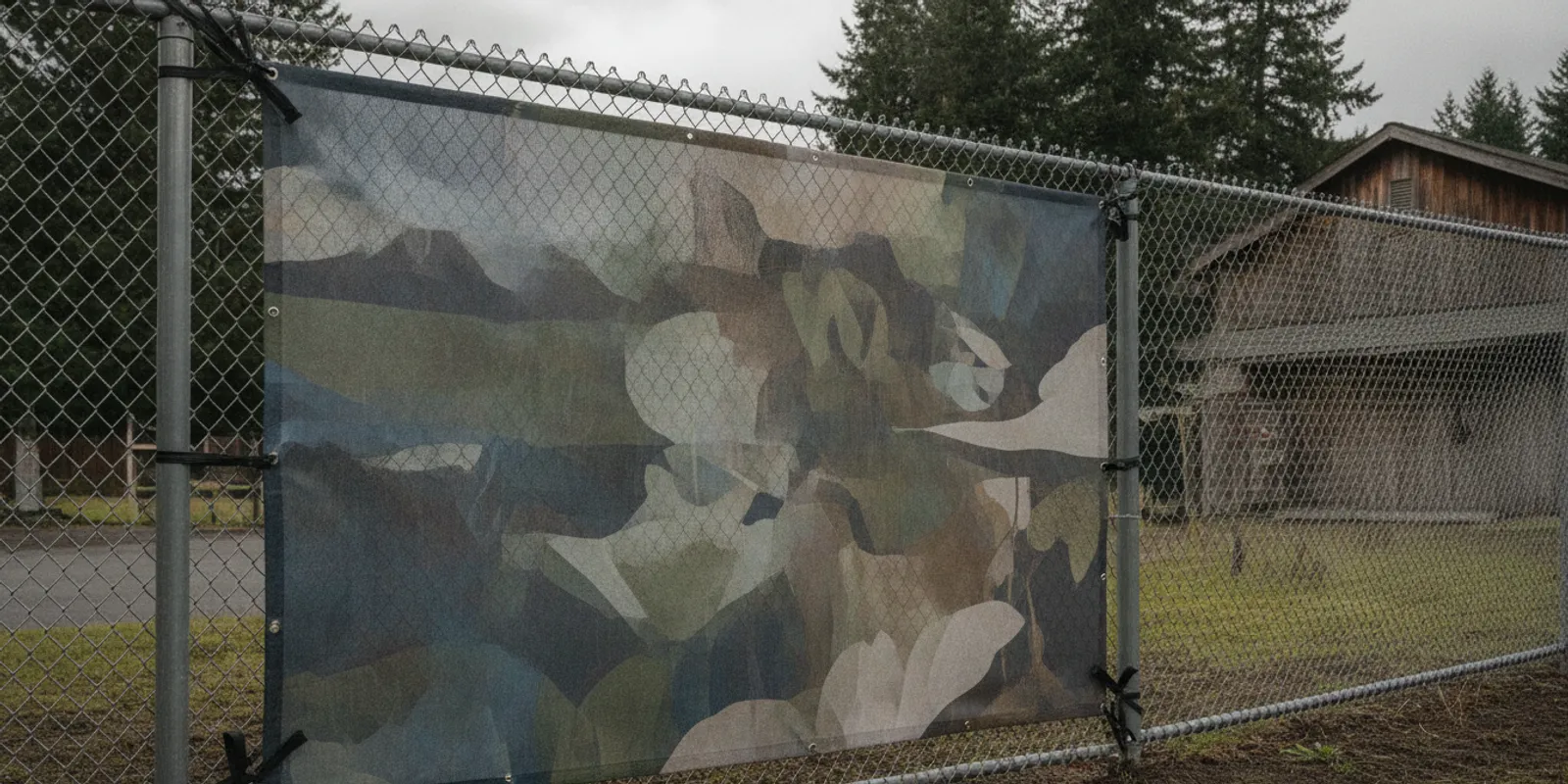
Custom mesh banners can be useful when a message needs to be seen outdoors and the display location is exposed to moving air. The right choice depends on more than the printed design: consider the site, mounting method, viewing distance, campaign duration and who will install the banner. This guide walks Portland-area businesses and organizations through those decisions before they request a quote.
Share your mesh banner project idea
When are custom mesh banners a good fit?
A mesh banner is worth considering when an outdoor display needs to communicate at a site where wind exposure is part of the planning. Its open construction can allow some air to pass through, unlike a continuous solid surface. That does not make a banner windproof, remove the force of gusts or guarantee that it will suit every location. The site, banner dimensions, material, edge finishing and attachment points all matter, so ask the printer to assess the intended use rather than selecting a format from appearance alone.
Start with the job the banner needs to do. Is it marking an entrance, identifying a temporary activity area, sharing a short campaign message or drawing attention to a business from across a parking area? A banner that works as a distant landmark may be too large or too visually busy for a close sidewalk approach. Likewise, a graphic that looks clear on a computer screen may lose its impact when viewed from a vehicle or through surrounding activity.
Mesh is not automatically the best answer just because the display is outdoors. A sheltered wall, temporary interior partition or other protected location might call for a different banner material or display system. Compare mesh with the available custom banner printing options, and consider whether a fabric banner or a banner stand better fits the location and way the display will be used. These are starting points for discussion, not a substitute for checking the specific product details and installation conditions.
What should you assess at the display site?
Walk the location and note what the banner will face. A site beside an open roadway, on an exposed building edge or in a gap between structures can experience different conditions from a sheltered courtyard. Buildings, trees and other obstacles can affect airflow, while local weather can change during a campaign. Do not assume that one visit on a calm day tells the whole story.
- Exposure: Note whether the site is open, sheltered, elevated or between structures. Describe what is around the banner, not just the address.
- Attachment surface: Identify the fence, frame, wall or other structure proposed for mounting. Take photos from several angles and point out any obstructions or uneven surfaces.
- People and vehicles: Record nearby walkways, entrances, parking areas and vehicle routes. The banner must be visible without creating an obstruction or an unsafe situation.
- Viewing direction: Stand where the audience will approach from. A banner seen head-on may read differently from one viewed at an angle.
- Duration: Say whether the display is for a short event, a seasonal campaign or repeated use. Duration affects decisions about material, handling, storage and maintenance.
- Site permissions: Confirm who controls the structure and whether approval is needed before installing anything. For public property, rented premises or shared facilities, check with the responsible authority or property manager.
Take photographs that show both the proposed banner area and the wider approach. Include a person, doorway or other familiar object in one image if it helps convey scale, but do not rely on that alone for measurements. Measure the usable width and height, and note where a frame, railing, corner or other obstruction limits the printable area. Share the measurements as estimates until the mounting surface and final dimensions have been confirmed.
For an outdoor campaign, use a current forecast as one planning input and check for relevant alerts as the display date approaches. The National Weather Service forecast and alerts can help you monitor conditions, but a general forecast cannot certify that a particular banner, structure or installation is safe. Ask the property owner and your print or installation provider how weather conditions affect the display and what action is appropriate if conditions change.
How should you compare mesh and other banner choices?
Different banner options address different project needs. Rather than choosing solely by the word “mesh,” compare where the piece will go, how it will be supported, how it should look from the audience’s viewpoint and whether the installation plan suits the site. The table is a planning aid; it does not promise a particular material specification or performance. Ask the provider to confirm product construction and suitability for your actual project.
| Planning option | When to consider it | Questions to resolve |
|---|---|---|
| Mesh banner | Outdoor display where airflow and exposure are important planning considerations | What material and finishing are proposed? What site and mounting details need review? |
| Solid banner | Display where a continuous printed surface is preferred and conditions support it | Is the location sheltered or exposed? How will the banner be supported? |
| Fabric banner | Project where fabric appearance or handling is a priority | Is it intended for the proposed location? How will it be displayed, cleaned and stored? |
| Banner stand | Display needs a freestanding support system or planned placement on a suitable level surface | What are the assembled dimensions, location limits and setup requirements? |
| Pole banner | Display is designed around a pole-mounted location and its specific hardware | Who approves the pole installation, and what mounting and access arrangements apply? |
APM PrintWorks offers mesh banners as a specific banner option. Ask the team what product details are available for your intended use, including dimensions, finishing and mounting considerations. If the project needs a pole-mounted display, review the separate pole banner option and make sure the physical site and approval process match that format.
How do size and viewing distance affect the design?
Plan the message for the distance and direction from which people will see it. A driver moving past a display has little time to read, while someone walking toward an entrance may have more time and may see the banner from several angles. Keep the main point easy to find. If the banner has to communicate a location, date or action, decide which information is essential and which can be omitted or shared through another channel.
Before design begins, gather the exact wording, approved brand assets, intended audience and any required contact or destination details. Identify the single primary message. Supporting details should not compete with it. A simple layout with clear contrast and generous spacing is often easier to take in at a glance than a packed design, but the right balance depends on the artwork, background and viewing conditions.
- Use a short headline that expresses the campaign or identifies the place.
- Make the most important words prominent enough for the expected viewing distance.
- Use a small number of supporting details; avoid treating the banner as a full information page.
- Check that text and important graphics remain clear against the artwork and the setting behind the display.
- Keep essential content away from areas that may be covered by hems, edges, fasteners or the support structure. Confirm the printer’s safe-area guidance.
- Provide the original, high-quality artwork files when available and include brand colors or usage guidance.
Do not guess at final scale by enlarging a low-resolution image. Ask the design or production team to review supplied assets at the intended output size. If a logo, photograph or illustration is central to the message, confirm that it is approved for use and that the file is suitable for the planned print. Make sure someone with authority to approve the artwork is available to review a proof promptly.
What should you decide about mounting and installation?
The mounting plan is part of the banner project, not a last-minute detail. A print-ready graphic still needs a suitable support and a clear plan for attachment. Tell the provider what structure will hold the banner, who owns it, whether the display will be reachable safely and whether the site has access restrictions. Send clear photographs and measurements, but do not assume a photo proves that the structure can carry the display or that a particular fastener is appropriate.
Ask what finishing is available for the selected banner and how it relates to your planned mounting method. The answer may depend on the product, dimensions and exposure. Confirm where attachment points will sit, how edges will be finished, and whether the support or hardware is included in the proposed scope. Do not order mounting components based on a generic online example: the exact product and site should guide the recommendation.
For a location with significant exposure, height or access challenges, involve the property manager and qualified installation personnel before agreeing to a layout. Clarify who is responsible for installation, what access equipment or permissions are required, and how the area will be managed during the work. If the banner will be installed by your own team, request product-specific handling and installation guidance and assign responsibility to someone familiar with the site.
Also agree on an inspection plan. Ask who will check the display after installation and during the campaign, what signs of damage or loosening require attention, and who should be contacted if the banner or support changes. Follow the product provider’s guidance and the site owner’s procedures. A banner should not be left in place simply because it was initially installed; conditions and attachment points may change.
How can you plan for Portland-area weather?
Greater Portland projects may face changing conditions over the course of a campaign, so plan for the actual location and dates rather than relying on a broad assumption about local weather. A sheltered display in Beaverton is not necessarily exposed in the same way as an open site elsewhere in the metro area. The height, orientation, nearby structures and how long the banner remains up all inform the questions to ask.
Mesh is often considered because its construction allows some air to pass through, but this does not mean it eliminates wind pressure or makes an installation suitable in every condition. The finished banner still presents a surface to wind, and its support and attachment matter. Do not interpret “mesh” as a safety rating. Ask the printer and installer to explain what is known about the proposed material and what assumptions they need to evaluate the project.
Before submitting a quote request, share the intended installation and removal dates, whether the display stays up overnight, and any weather-related constraints set by the site owner. Ask whether the planned material and finishing are suitable for the described use and what conditions should prompt removal or inspection. If the provider cannot assess a structural or site-safety question, seek advice from the responsible property or installation professional rather than treating a print quote as an engineering assessment.
For repeat campaigns, record what worked: where the banner was mounted, how it was handled, what weather it encountered and whether the message remained easy to see. Keep the approved artwork and project notes together. That history can make the next planning conversation more specific, though it does not replace checking the next site and conditions.
What should you include in a quote request?
Custom banner work is shaped by the project’s dimensions, material, artwork, finishing and installation needs. A useful request gives the printer enough context to ask informed follow-up questions. A number without a site description or intended use may leave important assumptions unresolved. APM PrintWorks works with Portland-area businesses and organizations as a local printer, and its banner services page is a starting point for discussing the right format.
Include these details in your project brief:
- Purpose: Explain what the banner needs to communicate and who should see it.
- Location: Give the site address or general area, the mounting surface and any known exposure or access conditions.
- Approximate dimensions: Provide measured width and height, plus photos that show the proposed area and nearby features.
- Dates: State when the display is needed, how long it will remain in place and whether the schedule includes installation or removal.
- Artwork status: Say whether final artwork is ready, who can approve it and whether design assistance may be needed.
- Mounting plan: Explain who owns the support structure, who will install the banner and whether hardware or installation needs to be considered.
- Quantity and reuse: Note how many displays are planned and whether the banner may be used again at another time or location.
- Decision priorities: Identify what matters most, such as a particular visual result, a specific display period or coordination with other campaign materials.
Ask for a quote that makes the assumptions visible. Confirm which banner material and finishing are included, what dimensions are being priced, whether artwork preparation is part of the scope, and whether mounting or installation is included or separate. Ask about proof review, production timing and delivery or pickup arrangements for your specific project. No standard price or schedule applies to every custom banner, so confirm the details directly instead of relying on a generic range.
When you compare proposals, make sure they describe the same job. A lower figure may not include the same finishing, artwork support, mounting components or installation. Clarify who supplies each part and who is responsible for site checks. If a proposal makes an assumption about exposure or structure, resolve it before approving production.
What should you check before approving the proof?
A proof is your opportunity to review what will be printed, not a substitute for checking the installation plan. Read the actual words carefully, including dates, names and any contact details. Check that the approved design matches the intended audience and can be understood at the likely viewing distance. Ask the approver to review the file on behalf of the organization, rather than assuming a design looks correct because it resembles an earlier campaign.
- Verify spelling, punctuation, dates and any required wording.
- Check colors, logos, image placement and overall contrast against the design brief.
- Confirm the final size and orientation match the approved location measurements.
- Review edges, safe areas and any finishing marks according to the proof and provider guidance.
- Confirm who gives final approval and how requested revisions will be handled.
- Make sure the quote and approved proof describe the same product and scope.
If a change is needed, describe it precisely and request an updated proof. Do not rely on a verbal note for a critical content change; make sure the final approved version reflects the correction. Keep a copy of the approved proof and quote with the project records so the organization can refer to them during installation and future reorders.
How should you care for and reuse a mesh banner?
Care depends on the specific material and finishing, so follow the product provider’s instructions rather than applying a one-size-fits-all cleaning method. Ask how to handle the banner during installation and removal, how to clean it if needed, and how it should dry before storage. Avoid folding or packing it while wet unless the product guidance permits that, and keep it away from sharp objects or conditions that could damage the printed surface.
After removal, inspect the banner and its edges. Note any damage, wear or attachment issues before deciding to use it again. Store it in a clean, dry place as directed, and label the package with the project name, date and dimensions. If the artwork includes a date, location or other time-sensitive detail, check that it remains accurate before reusing the banner. Reuse is only practical when both the printed message and the banner’s condition still fit the next project.
For campaigns with several locations, maintain a simple record for each one: banner size, location, mounting method, contact person and dates of use. That record makes it easier to plan transport and coordinate teams. It also prevents the assumption that a banner made for one support or site will fit another without review.
Request guidance for your banner project
Frequently Asked Questions
Are mesh banners windproof?
No. Mesh construction can allow some air to pass through, but that does not make a banner windproof or guarantee safe performance at a particular site. Material, dimensions, support, attachment and conditions all matter. Describe the location and ask the provider and responsible installer to review the project.
Is mesh always better than a solid banner outdoors?
No. The best option depends on the display location, desired appearance, exposure, mounting method and project requirements. Compare the product details for the actual site instead of assuming one format suits every outdoor use.
What information helps get a useful quote?
Share the intended purpose, approximate size, site photos, mounting surface, campaign dates, artwork status, quantity and who will install it. Ask the provider to state what material, finishing, proofing and other project elements are included.
Can I install a custom mesh banner myself?
That depends on the site, display, access and product guidance. Confirm who is responsible for installation and whether permissions or qualified personnel are needed. Do not assume the banner or support can be safely installed based only on its material type.
How far ahead should I plan?
Timing depends on the project scope, artwork readiness, approvals and installation requirements. Share the date you need the display and ask APM PrintWorks to confirm a schedule for your specific project before committing to a campaign date.
Talk with a Portland banner team about your plans
With the site, message, mounting plan and schedule defined early, Portland-area organizations can make a more informed decision about custom mesh banners and move into production with fewer open questions.